About Agave attenuata Salm-Dyck
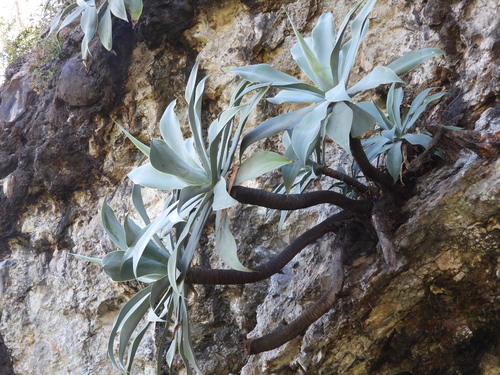
Agave attenuata Salm-Dyck. While particularly young or smaller plants may look acaulescent, mature plants typically grow stems between 50 and 150 cm (20 and 59 in) long. Older, desiccated leaves fall away to leave these woody stems visible. Its leaves are ovate-acuminate, 50–70 cm (20–28 in) long and 12–16 cm (5–6 in) wide. Leaf color is pale, ranging from light gray to light yellowish-green. There are no teeth or terminal spines, but leaves do taper to soft points that fray as they age. The numerous, broad, succulent, tapering leaves are slightly less rigid than the leaves of most Agave species; they are bright glaucous gray to light yellowish-green and stingless. The inflorescence is a dense raceme 2.5 to 3 meters (8.2 to 9.8 ft) high, and it is usually curved. It holds greenish-yellow flowers, and develops after many years of growth. Like other Agave species, this species is monocarpic. Instead of producing flowers from the side of its stem and continuing to live, as is common in succulent genera such as Crassula or Sedum, the entire rosette develops into the giant inflorescence. After many months, the bloom dies following pollination and seed development. However, numerous plantlets then sprout, both from the base of the original plant and from the flower raceme. In the wild, once the inflorescence dries and falls to the ground, the young plants growing from it root into the ground, forming a new colony. This species has two recognized subspecies: A. attenuata ssp. attenuata is native to Central and Southwest Mexico, and is naturalized in Madeira and Libya. A. attenuata ssp. dentata (J.Verschaff.) B.Ullrich is native to Northwest and Southwest Mexico. The first specimens of this species were sent to Kew Gardens by explorer Galeotti in 1834, from an unspecified location in central Mexico. A more recent study has reported the species from Jalisco (on Mexico’s west coast) and east of Mexico State, where it grows in small colonies at elevations between 1,900 to 2,500 meters (6,200 to 8,200 ft). Few sightings of the species have been recorded, indicating it is rare in the wild. The IUCN records the species from the Mexican states of Colima, Durango, Guerrero, Jalisco, Michoacán, Nayarit and Mexico State. It grows at altitudes between 400 and 2,500 meters (1,300 and 8,200 ft) on volcanic rock cliffs, within pine forests and mountain transitional zones between tropical dry and temperate forest types. It is reported to be naturalized in Libya and Madeira, and is widely distributed across the Mediterranean and the rest of Macaronesia. In cultivation, Agave attenuata prefers relatively moist loamy soil, but it can tolerate poor soil and dry conditions. It requires protection from direct summer sunlight and from long periods of frost. It is hardy down to USDA Zone 9b.