About Agave amica (Medik.) Thiede & Govaerts
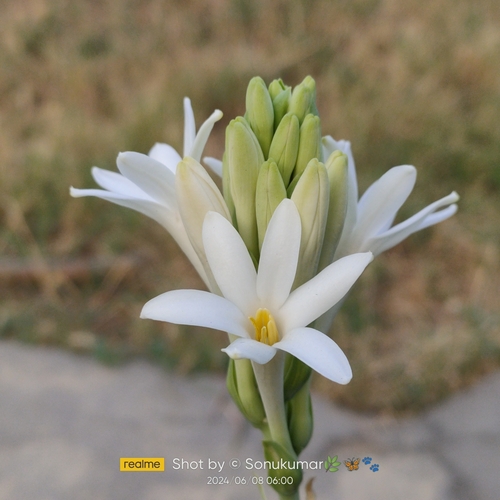
This plant, commonly known as tuberose with the scientific name Agave amica (Medik.) Thiede & Govaerts, is a herbaceous species that grows from underground tubers or tuberous roots and produces offsets. Its leaves are dull green, slightly succulent, 30 to 50 cm (1 to 1.5 ft) long, and up to 13 mm (0.5 in) wide at the base. The inflorescence is a spike that can reach 1 m (3 ft) in height, bearing pure white waxy flowers. The flowers are tubular, with a flower tube up to 6 cm (2.5 in) long that splits into six flaring tepal segments at the end; they are strongly scented, with six stamens inserted into the flower tube and a three-part stigma. The double-flowered cultivar 'The Pearl' has broader, darker leaves and shorter flower spikes that typically only reach 50 to 60 cm (1.5 to 2 ft). Orange-flowered forms of this species have been reported, and crossing with other species has produced additional cultivated forms with yellow, pink, red, and greenish flowers. Tuberose is thought to be native to central and southern Mexico, and it is no longer found growing in the wild, likely as a result of domestication by the Aztecs. Today it is cultivated in many tropical and temperate countries. When it was previously classified in genus Polianthes as Polianthes tuberosa, this was the only species from the genus grown in commercial cultivation. Tuberose can be overwintered outdoors in USDA hardiness zones 8 through 10. In colder zones, it is grown as a summer annual, planted in pots or mixed flower borders to be enjoyed for its fragrance. Plants require approximately four months of warm temperatures from the time the rhizome is planted to produce flowers. Gardeners usually start rhizomes in pots in greenhouses in late winter or early spring, then move them outdoors in late spring once the risk of frost has passed. If rhizomes are planted directly into the ground at this time, they may not bloom until September, which greatly shortens the period that their flowers can be enjoyed. When foliage turns yellow in October, the leaves should be clipped, and the rhizomes dug up and stored in a cool, dry, dark place for the winter. The most popular variety is the double-flowered cultivar 'The Pearl', which grows 76 cm (2.5 ft) tall and has pale pink buds that open to cream-colored blooms. The more common variety is 'Mexican Single', which is less decorative than 'The Pearl' but produces longer-lasting cut flowers. Tuberose was especially favored by Louis XIV of France, who planted hundreds of the plants in the flower beds of the Grand Trianon at Versailles. The strong scent was meant to overpower unpleasant smells coming from the palace's poor sanitation. The plants were grown in clay pots and planted directly into the ground, and new specimens were rotated in, sometimes daily, to keep the perfume consistently strong.