About Agave americana subsp. americana
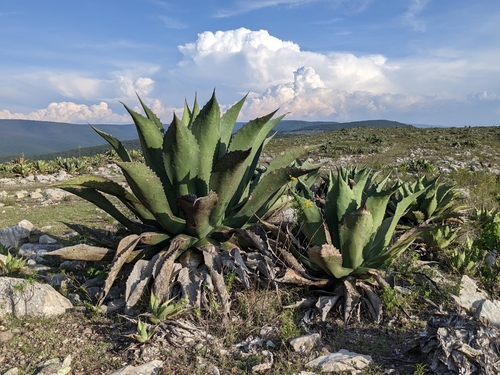
Its common name "century plant" comes from its monocarpic growth habit: it flowers only once at the end of its long life, then dies after blooming. Before dying, the plant produces adventitious new shoots from its base, so its population continues to spread. Despite the name "century plant", this subspecies typically only lives 10 to 30 years. Mature plants reach a spread of 1.8–3.0 m (6–10 ft). Their gray-green leaves are 0.9–1.5 m (3–5 ft) long, each has a prickly margin and a heavy sharp spike at the tip that can pierce deeply into skin or tissue. Near the end of its lifespan, the plant grows a tall, branched flower stalk topped with yellow blossoms; this stalk can reach 8–9 m (25–30 ft) in height.
Agave americana is cultivated as an ornamental plant, and is especially valued for its large, dramatic mature form. It is commonly grown in modernist gardens, xeriscapes (drought-tolerant landscaping designs), and desert-style cactus gardens. It is a popular landscaping plant in hot climates and regions prone to drought. The presence of this plant can evoke the atmosphere of 18th- to 19th-century Spanish colonial and Mexican provincial areas in the Southwestern United States, California, and the dry, xeric regions of Mexico. It is a favored landscaping choice for dry beach gardens in Florida and coastal areas of the Southeastern United States. When grown as a houseplant, A. americana tolerates light levels ranging from full direct sunlight to shade, and requires very little watering. It has a winter resting period that occurs when temperatures are around 10 to 12 °C (50 to 54 °F). It grows best in highly porous, sandy potting soil, should be allowed to dry out completely between waterings, and needs to be repotted annually each spring.
Agave americana contains agavose, a sugar that is an isomer of sucrose (C₁₂H₂₂O₁₁), but has lower sweetening power. It also contains agavasaponins and agavosides. It has been used in traditional medicine to treat a range of different ailments, and used specifically as a laxative, diuretic, and diaphoretic. However, a comprehensive systematic scientific review of existing research literature found insufficient data to confirm that this use is either effective or safe. It should also be noted that contact with A. americana can cause severe allergic dermatitis.