About Agaricus xanthodermus Genev.
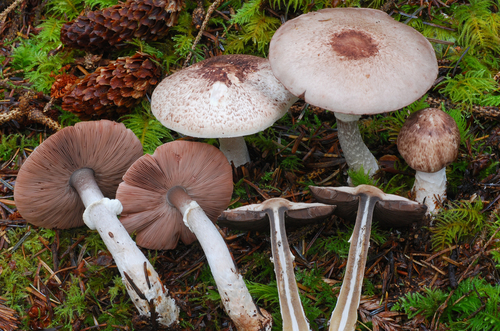
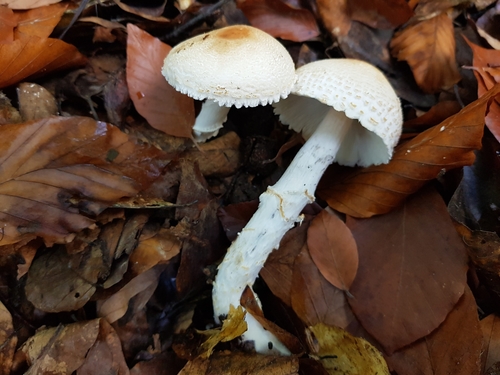
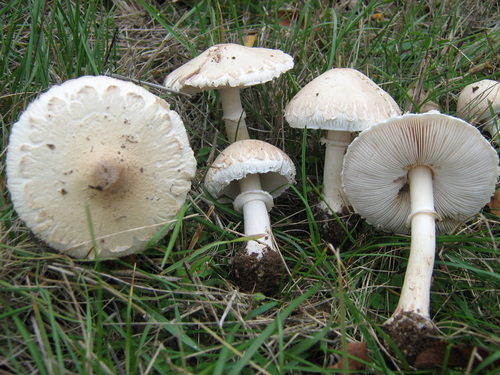
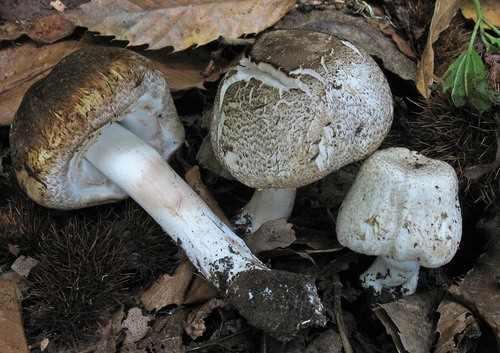
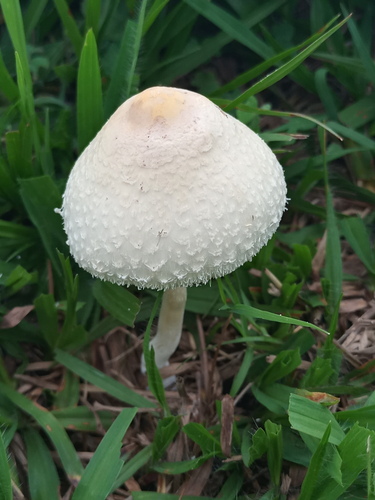
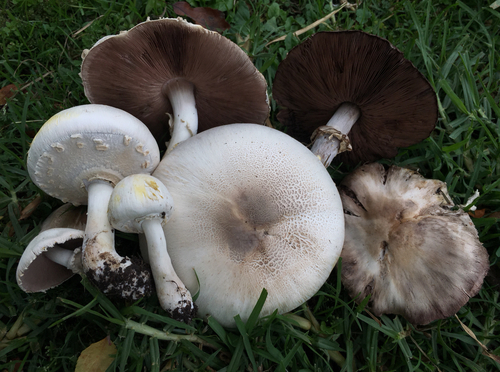
Agaricus xanthodermus Genev. has a cap that is 5 to 15 centimeters (2 to 6 inches) in diameter. Young caps are initially convex, and some young specimens have a squarish shape; caps flatten as they age. The cap is whitish, with light brown coloring toward the center. It is dry and smooth, and may become scaly when the mushroom is old. The gills change color from pale-pink to chocolate brown as the mushroom matures. The stipe (stem) is white, measures 5–12 cm (2.0–4.7 in) tall and 1–3 cm wide, and is bulbous with a skirt-like ring. Microscopically, the cheilocystidia of this species are club-shaped. Its spores are brown, elliptical, and smooth, with dimensions of 6–7 × 3–4 μm. Agaricus xanthodermus has an unpleasant characteristic phenolic smell, similar to ink or carbolic soap, that is especially strong at the base of the stem. The smell becomes very noticeable when the mushroom is cooked, which may prevent people from accidentally eating it. This mushroom is very common and widely distributed across North America, Europe, West Asia (including eastern Anatolia and Iran), North Africa, and southern Africa. It has been introduced into Australia. It grows in woods, lawns, gardens, and hedgerows during autumn, and it is a saprobic species. While some people can eat this mushroom without experiencing illness, it contains toxins that cause serious gastrointestinal upset. It is indigestible, and poisoning causes symptoms including sweating, flushing, and severe stomach cramps. It is classified as poisonous, and its sale is specifically prohibited in Italy. Among people who forage Agaricus-style mushrooms, around 50% of mushroom poisoning cases are caused by this species.