About Agaricus placomyces Peck
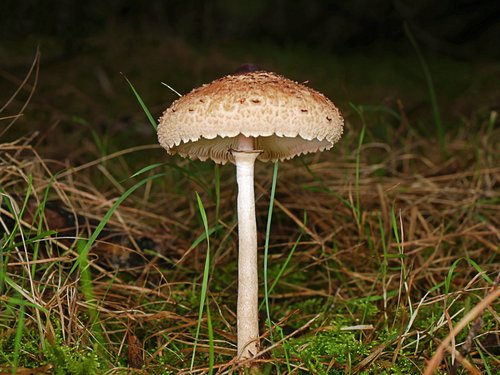
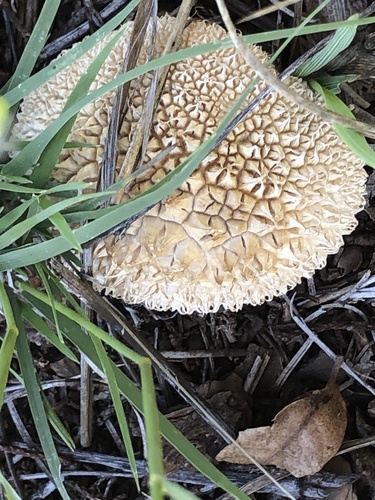
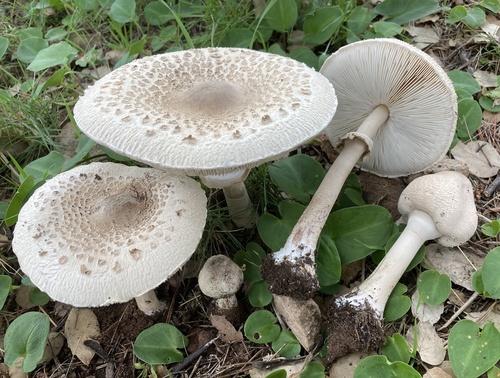
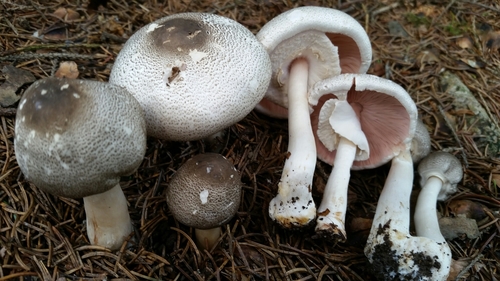
Agaricus placomyces Peck has a cap 5–13 centimetres (2–5 inches) wide, which changes shape from convex to broadly convex or nearly flat as it matures. The cap surface is dry, covered with brownish fibers and scales that are particularly concentrated over the center. The cap flesh is whitish in typical conditions, and may turn pinkish in wet weather. The cap is thick, covered in fine, appressed greyish-brown scales concentrated at its center, and slowly turns vinaceous when injured; it has an odor of phenol. The mushroom’s flesh is white, and turns yellow when placed in KOH. The gills are free from the stem, crowded, and pale grayish-pink, turning brown as the mushroom ages. The stem (also called stipe) is 6–15 cm long, 1–1.5 cm thick, roughly equal in shape along its length, with an enlarged base, unlike the small bulb typical of Agaricus pocillator. The stipe surface is fairly smooth, white, and bruises yellow especially at the base; it bears a persistent ring. When the partial veil is still covering the gills, it develops brownish to yellowish droplets. Other sources describe the stipe as 8–15 cm long, 2–3.5 cm thick, slightly enlarged at the base, with a white, smooth surface both above and below the ring. The stipe’s veil is membranous, thick, and white, forming a persistent ring with smooth surfaces on both its upper and lower sides. The base of the stipe typically turns yellow when bruised and smells of phenol. The spores are smooth and elliptical, measuring 4–6.0 x 3.5–4.5 μm; the spore print is dark brown. Agaricus placomyces is saprobic. It grows in groups under hardwoods and in mixed woods during summer and fall, and is generally found east of the Rocky Mountains, with a northern distribution. It can also occur solitary, in small groups, or in clusters on disturbed ground under conifers. Unlike many other Agaricus species, some populations fruit from mid to late winter instead of late spring, summer, and early fall. Agaricus placomyces contains toxins that cause gastrointestinal upset, similar to other phenolic-odored Agaricus species. Some people are reported to not be affected by these toxins. The mushroom has a mild taste, and an odor resembling phenol or coal tar.