About Agaricus deserticola G.Moreno, Esqueda & Lizárraga
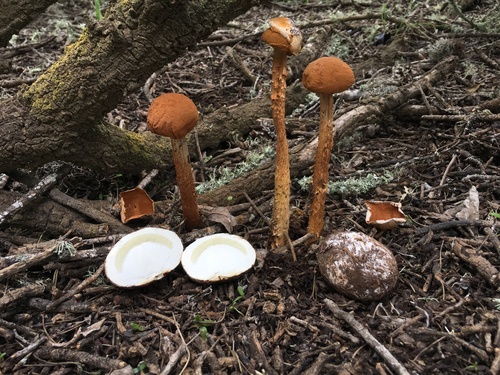
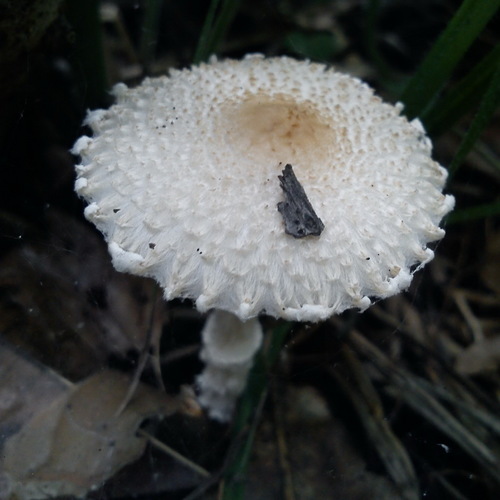
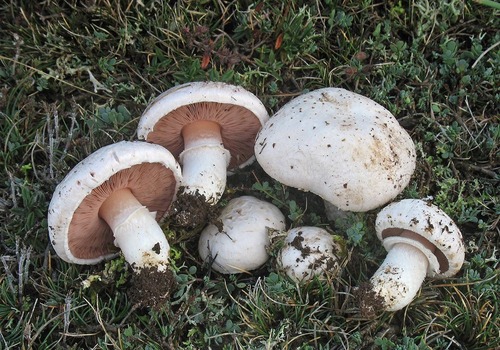
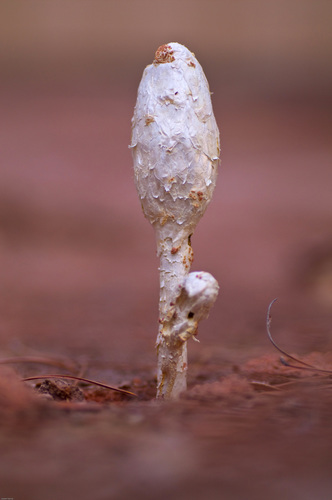
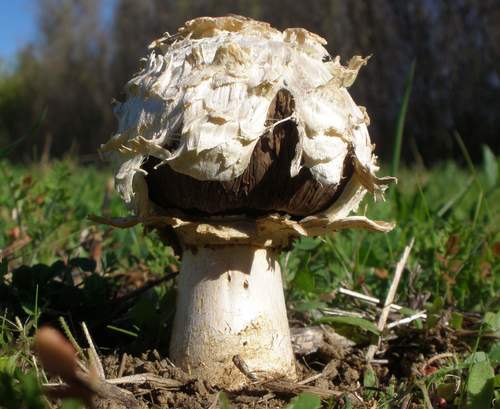
The fruit body of Agaricus deserticola reaches 5 to 18 cm (2 to 7 in) in height. Fresh specimens are typically white, fading to pale tan as they age, while dried fruit bodies are light gray or tan mixed with yellow. The cap measures 4 to 10 cm (1.5 to 4 in) in diameter; it starts out conical, and becomes convex to broadly convex as it matures. The cap is made of three distinct tissue layers: an outer volval layer, a middle cuticular layer (cutis), and an inner (tramal) layer that supports the gleba. The cap surface is white with small raised scales that have yellow-brown to brown tips; these scales form when the volva and cutis break apart. Young caps are fully covered by a peridium, an outer tissue layer. As the fruit body matures and dries, the lower part of the peridium begins to tear, usually starting with small longitudinal slits near where the peridium attaches to the top of the stem. Tearing patterns are variable: slits may form higher on the peridium in some individuals, while tearing is more irregular in others. Tearing can also leave a ring-like structure of peridium tissue at the top of the stem. Torn peridium exposes the internal gleba, which is divided into wavy plates (lamellae), some of which fuse together to create irregular chambers. The gleba is drab brown to blackish-brown, and becomes tough and brittle as it dries. Young flesh is firm and white, and stains light to bright yellow when bruised. The stem is cylindrical, 4 to 15 cm (1.5 to 6 in) long, and 2 to 4 cm (0.8 to 1.6 in) thick. It is shaped like a narrow club, and its base may reach up to 4.5 cm (1.8 in) wide. The stem is typically white, stains yellow to orange-yellow or pink when bruised, and becomes woody with age. Mature stems develop longitudinal grooves. Numerous white rhizoids (root-like outgrowths of fungal mycelium that anchor the mushroom to its substrate) grow at the stem base. The apex of the stem extends into the gleba to form a columella that reaches the top of the cap. The internal gills do not attach to the stem, but are attached along their full length to the inner surface of the cap. The partial veil is thick and white, and often sloughs off as the cap expands. Zeller described a larger variety, Agaricus deserticola var. major (originally Longula texensis var. major), whose range overlaps with the typical variety. It has scalier caps than the typical variety, with cap diameters ranging from 6 to 12 cm (2.4 to 4.7 in) or more, and stems 10 to 25 cm (3.9 to 9.8 in) long and up to 4.5 cm (1.8 in) thick. In spore deposits like spore prints, A. deserticola spores appear almost black with a purple tinge. The spores are spherical to nearly spherical, smooth, thick-walled, and lack a germ pore. They are nonamyloid (do not absorb iodine when stained with Melzer's reagent), black-brown, and measure 4.5–7.5 by 5.5–6.5 μm. A prominent scar marks where the spore was once attached to the spore-bearing basidium via the sterigma. Basidia are broadly club-shaped, mostly four-spored, and have long, slender sterigmata. Unlike other Agaricus species, A. deserticola spores are not forcibly discharged; instead, they disperse by sifting out of dried mature fruit bodies after the peridium breaks open. Schaeffer's chemical test, commonly used to identify and differentiate Agaricus species, produces a red or orange color for positive results. A. deserticola gives a positive Schaeffer's reaction, similar to species in section Arvensis of the genus Agaricus. Like other Agaricus species, A. deserticola is saprobic, meaning it feeds on dead or decaying organic matter. Fruit bodies grow singly or sometimes in greater numbers, at low elevations, usually in sandy soil. Common habitats include drylands, coastal sage scrub, and desert ecosystems, and it also grows in lawns and fields. This fungus is only found in southwestern and western North America, where it fruits year-round, typically during or after cold, wet weather. Zeller recorded that its range extends east to central Texas, west to San Diego County, California, and north to Josephine County, Oregon. Before land development reduced its preferred habitat, the species was common in the San Francisco Bay Area. A. deserticola has also been collected in several northwestern Mexican states: Sonora, Chihuahua, and Baja California.