About Agaricus campestris L.
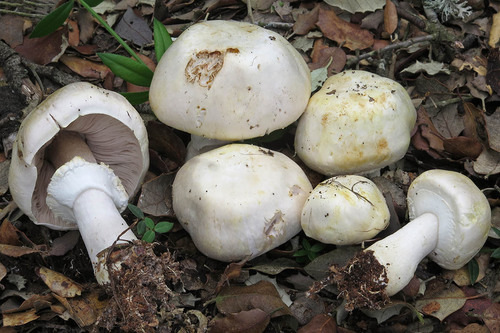
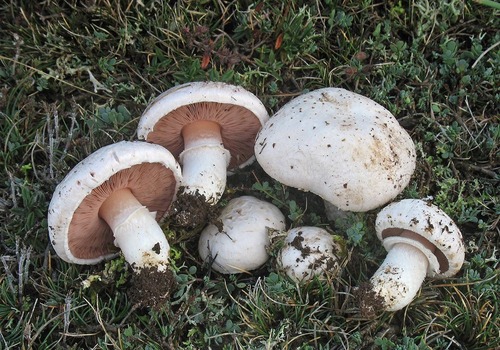
Agaricus campestris L. has a white cap that may bear fine scales, measuring 3 to 12 centimetres (1+1⁄4 to 4+3⁄4 inches) in diameter. When young, the cap is hemispherical, and it flattens out as it matures. Its gills start out pink, turn red-brown, and finally become dark brown; the spore print is also dark brown. The stipe grows 3 to 10 cm (1+1⁄4 to 4 in) tall and 1–2 cm wide, it is mostly white, and has a single thin ring. The mushroom has a mild taste. Its white flesh bruises to a dull reddish brown, which distinguishes it from the poisonous Agaricus xanthodermus and similar species, whose flesh bruises yellow. The dark brown, elliptical, thick-walled spores of this species measure 5.5–8 μm by 4–5 μm, and cheilocystidia are absent. In terms of habitat and distribution, A. campestris grows in fields and grassy areas worldwide after rain starting from late summer. It often appears on suburban lawns, growing in small groups, forming fairy rings, or growing solitary. Due to the end of widespread use of horse-drawn vehicles and the resulting reduction in horse populations on pastures, the large abundant fruiting events known as "white outs" that used to occur have become rare. This species is rarely found in woodland. It has been recorded in Europe, Asia, north Africa, Australia, New Zealand, and North America including Mexico. Although it is an edible, high-quality mushroom, it is not grown commercially because it matures quickly and has a short shelf life. Foragers must take care to tell it apart from poisonous lookalike species; notably, there have been cases in France where people mistakenly ate the deadly Amanita virosa thinking it was this mushroom. Additionally, specimens collected from lawns may be contaminated with pesticides or other chemicals. In cooking, this mushroom can be eaten sauteed or fried, added to sauces, or even served sliced raw in salads. In both flavor and texture, it is similar to the common cultivated white button mushroom (A. bisporus) sold in grocery stores across most Western countries. For other uses, ongoing research is testing fungal dressings made from fungal mycelial filaments that use this species to treat ulcers and bed sores. In the past, people in parts of Scotland applied slices of A. campestris to scalds and burns.