About Agaricus bisporus (J.E.Lange) Imbach
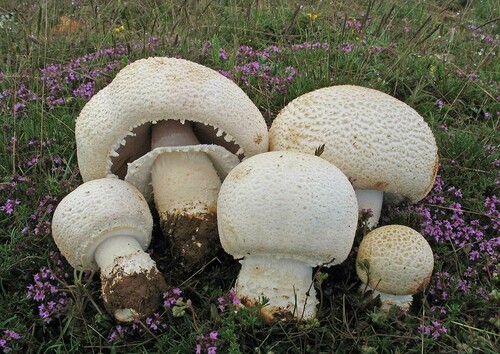
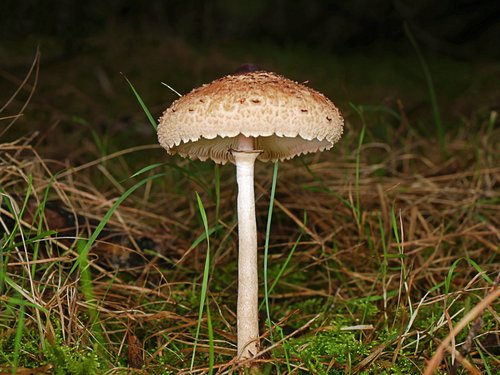
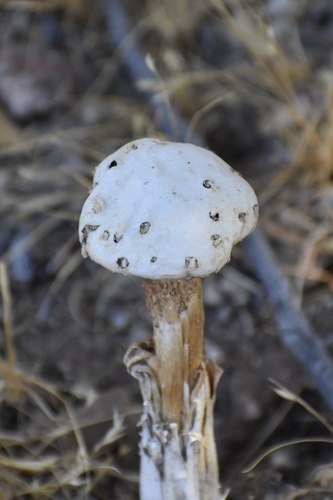
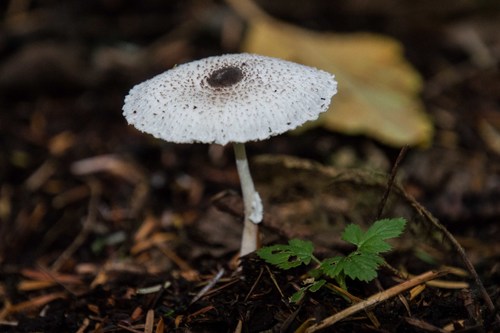
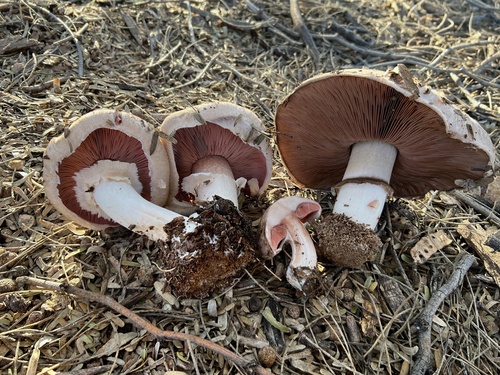
The original wild Agaricus bisporus has a pale grey-brown pileus (cap), with broad, flat scales on a paler background that fade toward the cap margins. When young, the cap is hemispherical, and it flattens out as it matures. It typically measures 5–10 centimetres (2–4 inches) in diameter. The narrow, crowded gills are free from the stipe. They start out pink, then turn red-brown, and finally become dark brown, with a whitish edge formed by cheilocystidia. The cylindrical stipe grows up to 6 cm (2+1⁄2 in) tall and 1–2 cm (1⁄2–3⁄4 in) wide, and bears a thick, narrow ring that may be streaked on its upper surface. The firm flesh is white, and stains pale pinkish-red when bruised. The spore print of this species is dark brown. Its spores are oval to round, measuring approximately 4.5–5.5 μm × 5–7.5 μm. Basidia are usually two-spored, although two four-spored varieties have been described: one from the Mojave Desert with a predominantly heterothallic lifestyle, and one from the Mediterranean with a predominantly homothallic lifestyle. This mushroom is widespread worldwide. It fruits from autumn to winter, growing especially in association with cypress, rich soil, compost, and manure.