About Agaricus bernardii Quél.
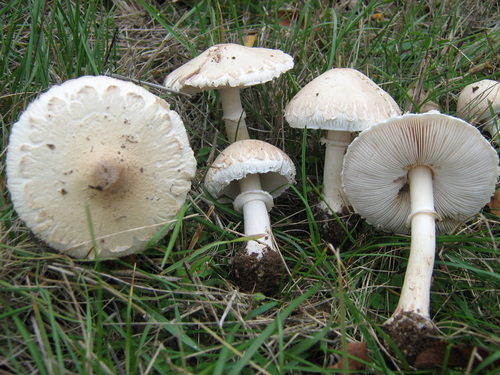
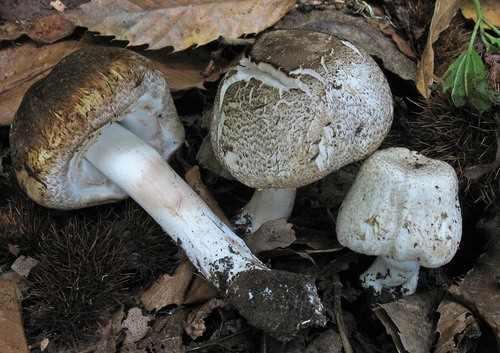
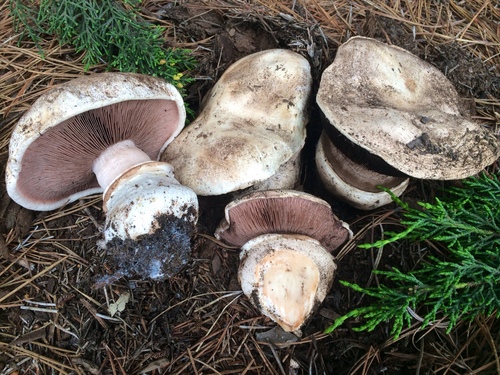
Fruit bodies of Agaricus bernardii have caps that range in shape from convex to flattened, reaching a diameter of 5–15 centimetres (2–6 inches). The cap surface is dry, smooth, and white or buff, and may develop brownish spots as it matures. Older fruit bodies often develop scales or warts on the cap surface. The flesh is thick and firm, and stains reddish-orange or reddish-brown when cut, though this color change can develop slowly. Its odor varies from mild, to briny, to pungent. The gills do not attach to the stem and are packed closely together. They start out grayish-pink to pinkish, then turn reddish-brown, and finally become chocolate brown as spores mature. The stem is solid (not hollow) and firm, measuring 4–10 cm (1+1⁄2–4 in) long by 2–4 cm (1–1+1⁄2 in) thick. Immature mushrooms have a thick, white, rubbery partial veil covering their gills; this veil eventually remains as a ring around the middle of the stem. A. bernardii produces a dark brown spore print. Its spores are smooth, broadly elliptical, and measure 6–7.5 by 5–6 μm. Spore-bearing cells called basidia are four-spored and club-shaped, measuring 14–25 by 4–7 μm, with sterigmata 4–5 μm long. Cheilocystidia, cystidia found on the gill edge, are broadly club-shaped to cylindrical, hyaline (translucent), and measure 17–30 by 4–8 μm. This species is distributed across Asia, Europe, North America including Mexico, and New Zealand. A. bernardii is a saprobic species. Its mushrooms fruit singly, scattered, or in groups on the ground, growing in sandy soils, lawns, and habitats with high salt concentration such as ocean coasts and salt marshes. Once primarily a maritime species, the fungus has spread inland to roadside verges where salt is applied for road de-icing. Fruit bodies sometimes form underground, and may also grow in fairy rings, particularly in grasslands or pastures. A Czech study found that A. bernardii mushrooms strongly bioaccumulate silver from contaminated soil. While average silver concentration in unimpacted soil is typically less than 1 milligram per kilogram of soil, concentrations can be significantly elevated near industrial sites like mines and smelters. Silver concentration in A. bernardii caps reaches up to 544 mg per kg of dry mushroom tissue, about twice the concentration found in stems. Though A. bernardii mushrooms sometimes have a briny or pungent odor, they are edible and considered good. Author David Arora compares the species to the closely related Agaricus bitorquis, noting it is "but a little chewier".