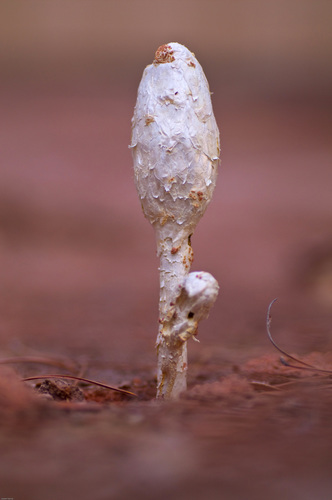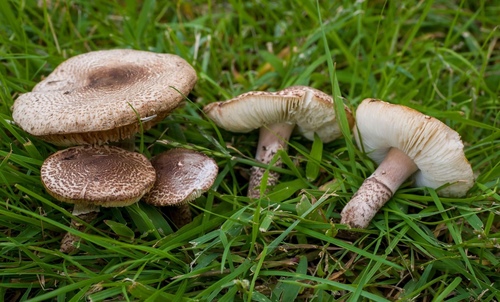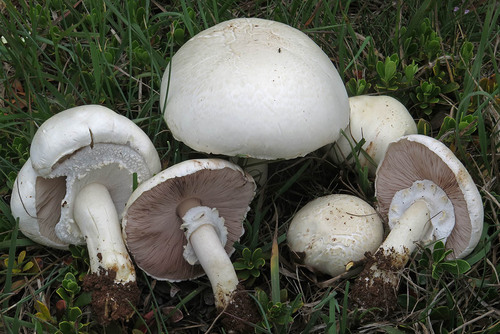
About Agaricus arvensis Schaeff.
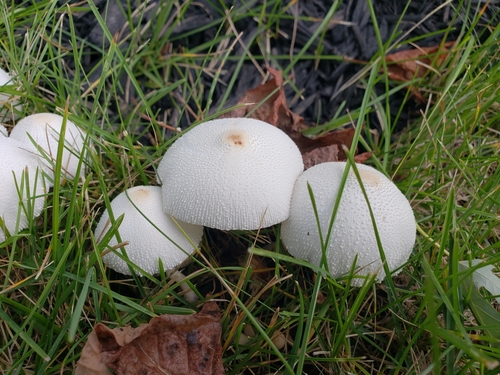
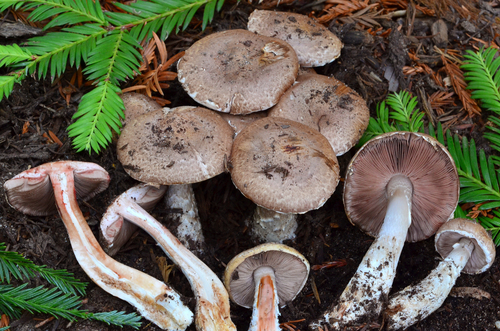
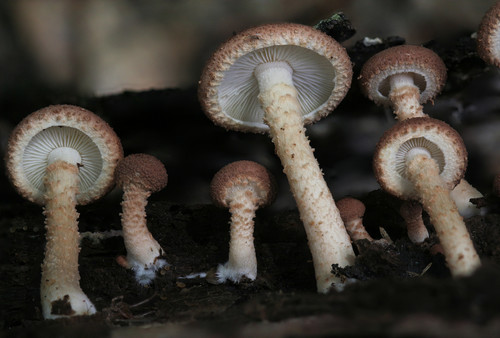
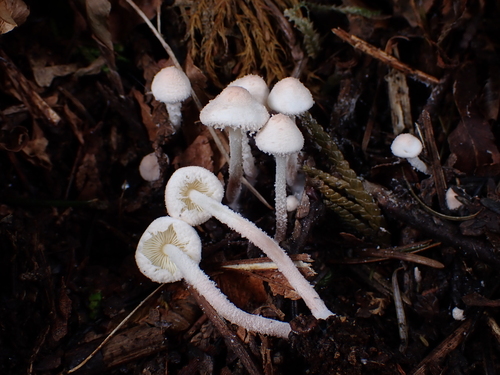
The cap of Agaricus arvensis Schaeff. measures 7–20 cm (3–8 in) across; it is whitish, smooth, and dry, and turns yellow when stained, especially when young. The gills are initially pale pink to white, then change color through grey and brown before becoming dull chocolate brown. This species has a large, spreading ring: the upper surface of the ring is white, while the underside sometimes bears yellowish scales. When viewed from below on a mushroom with a closed cap, the twin-layered ring shows a distinct "cogwheel" pattern around the stipe, formed by the lower portion of the double ring. The stalk grows 5–12 cm (2–4+1⁄2 in) long and 1–3 cm wide. The spores are brown and smooth, and they produce a dark brown spore print. The mushroom smells similar to almond extract or marzipan, a scent caused by the presence of benzaldehyde. It typically turns yellow when bruised. Agaricus arvensis is one of the largest white Agaricus species found in Britain, where it fruits from July to November; it is also found in West Asia (Iran) and North America. It grows frequently near stables and in meadows, and may form fairy rings. It is often found growing alongside nettles, which also favor nutrient-rich soil. On the North American West Coast, it is associated with cypress, while it grows in association with spruce in eastern North America.