About Agaricus arorae Kerrigan
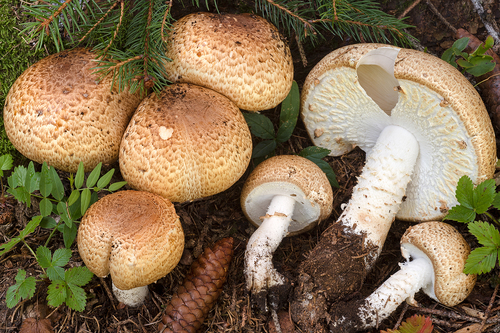
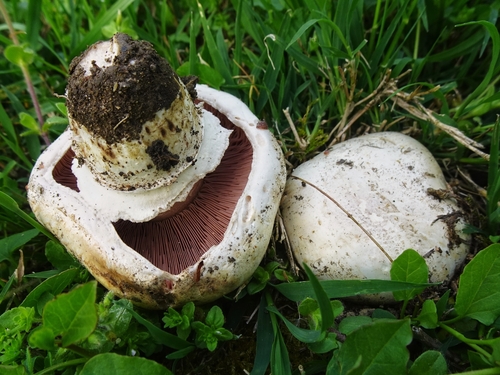
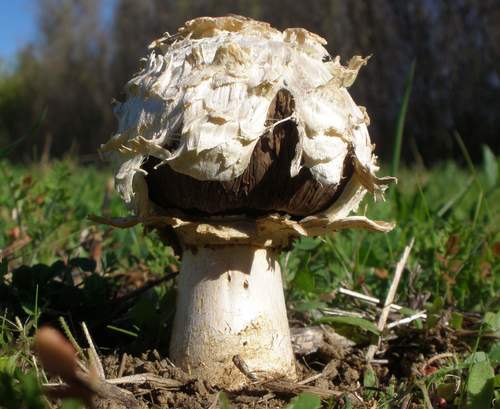
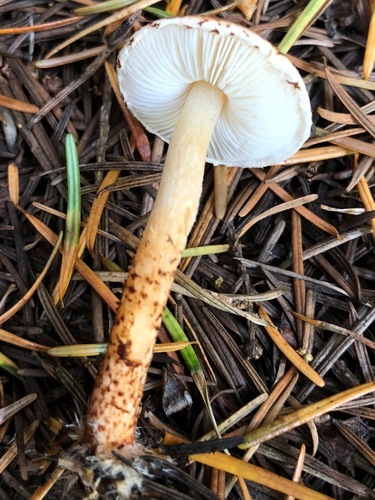
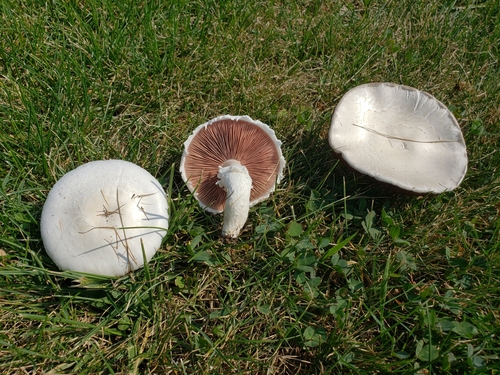
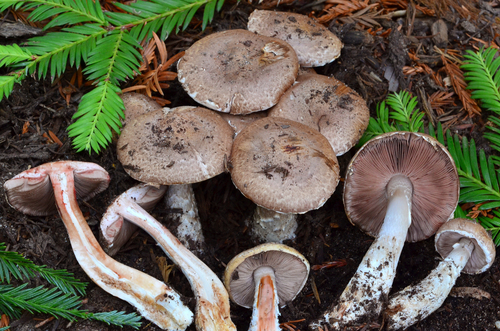
Agaricus arorae Kerrigan has a cap 3–7 centimetres (1+1⁄4–2+3⁄4 in) wide, which is convex when young before becoming flattened. Caps range in colour from white to reddish, with brownish fibrils or scales concentrated in the centre, and sometimes appearing across the rest of the cap. The cap surface yellows when treated with potassium hydroxide (KOH), and the flesh slowly bruises reddish when damaged. The cap surface is dry; the central disc of the cap may be either glabrous or tomentose. This species has an indistinct odour and a mild taste. The context (inner flesh) can grow up to 5 mm thick, has a soft texture, and bruises an irregular vinaceous colour when cut. The gills are free from the stipe and spaced closely together. They are pinkish when young, then darken to dark brown as the mushroom matures. Spores measure 4–5.5 by 3–4 μm, are elliptical, smooth, and inequilateral when viewed in profile. They have moderately thick walls, and do not have a germ pore. The stipe is 5–14 cm long and 0.5–2 cm thick. It is slightly enlarged at the base, and becomes hollowed (stuffed) as the mushroom reaches maturity. The white veil is rather membranous, and leaves a thin ring on the stipe after opening. When cut, the stipe cortex discolours to pinkish-orange. The stipe base turns brown to rusty-brown when handled. The stipe margin is sometimes light brown. The apex surface of the stipe is white with patchy fibrils, growing over a dull-buff ground colour. Agaricus arorae resembles Agaricus amicosus, Agaricus bisporus, Agaricus fuscofibrillosus, and Agaricus spissicaulis. When scales are present, it can be distinguished from related species by its conspicuous stipe and the scales it bears. Agaricus arorae was first formally described from specimens collected in Santa Cruz County, California, and has since been found in San Mateo County and Alameda County as well.