About Agapanthus africanus (L.) Hoffmanns.
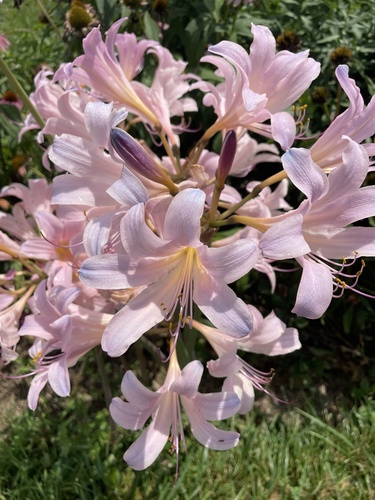
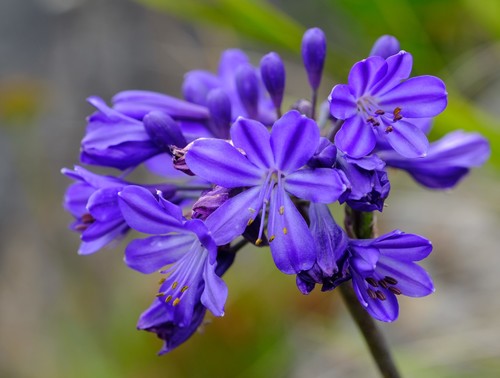
Agapanthus africanus (L.) Hoffmanns. is a rhizomatous evergreen geophyte that reaches 25 to 70 cm (10 inches to 2 feet 4 inches) in height. It produces leathery, suberect, long, strap-shaped leaves. Its flowers are broadly funnel-shaped, thick-textured, and range from pale to deep blue, with a dark blue stripe running down the center of each petal. Paler flowers are more common in Agapanthus africanus walshii, while Agapanthus africanus africanus typically produces darker flowers. Flowers form in large clusters, and each individual flower measures 25–40 mm (31⁄32–1+9⁄16 inches) long. This species flowers from November to April, especially after fire, with peak flowering between December and February. Pollination is carried out by wind, bees, and sunbirds, and seeds are dispersed by wind. Chacma baboons and buck sometimes eat the flower heads just as the first flowers begin to open. These plants are adapted to survive fire in the fynbos, and resprout from their thick, fleshy roots after fire passes through the area. Compared to the more common Agapanthus praecox, this species is less suitable for garden cultivation because it is much more difficult to grow. A. africanus subsp. africanus can be grown in rockeries in a well-drained, slightly acid sandy mix. It grows best in shallow pots, and will flower regularly when fed with a slow release fertiliser. A. africanus subsp. walshii is the most difficult Agapanthus to grow. It can only be grown as a container plant, and will not survive if planted in the ground. It requires a very well-drained, sandy, acid mix with minimal watering in summer. Both subspecies need a climate with hot, dry summers and winter rainfall, and cannot tolerate extended freezing temperatures. The name A. africanus has long been incorrectly used for A. praecox in horticulture and publications worldwide, and all horticultural plants sold as A. africanus are actually hybrids or cultivars of A. praecox. Extracts from A. africanus have been shown to have antifungal properties. When these extracts are applied to the seeds of other plant species, including economically important varieties, they significantly reduce the severity of impacts from certain pathogens. For sorghum, this extract performed better than Thiram, a common fungicide, when the plants were exposed to Sporisorium sorghi and S. cruentum. Extracts also induce resistance to leaf rust in wheat by increasing the activity of pathogenesis related proteins.