About Agalinis auriculata (Michx.) S.F.Blake
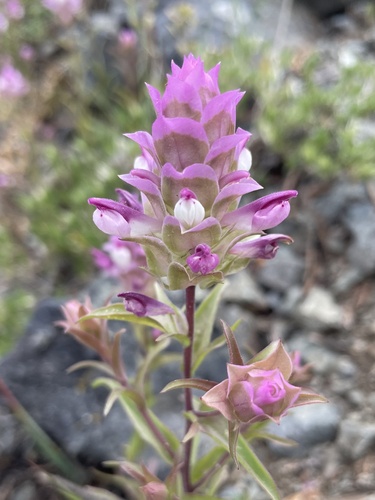
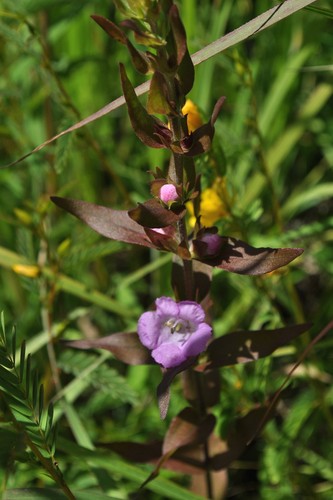
Agalinis auriculata is a hairy annual herb that grows a stiff stem up to 90 cm (35 in) tall. Its leaves are arranged oppositely on the stem; the stems have retrorse-hispid hairs, and the leaves are auricled. The plant produces purple, five-cleft flowers, with two smaller upper lobes that are more united than the three lower lobes. The flower throats are purple-spotted, and blooming occurs between July and September. This species is currently considered vulnerable. The Center of Biodiversity is conducting research on the genetic diversity and disturbances affecting Agalinis auriculata, to improve understanding of its distribution and habitats. Agalinis auriculata is hemiparasitic: it produces chlorophyll to carry out photosynthesis, but also acts as a parasite on other plants to obtain some nutrients. In cultivation, this plant successfully parasitized Helianthus occidentalis (western sunflower) and Rudbeckia fulgida (showy black-eyed Susan); in the wild, it has been observed connecting to a grass, likely Poa compressa (Kentucky bluegrass). This species has a wide geographical distribution, and was formerly more common than it is today. Seed germination in this plant appears to require soil disturbance; in the past, this disturbance was likely caused by roaming bison herds. The plant can colonize mounds of earth turned over by pocket gophers (Geomys bursarius). Today, there are 40 to 50 known occurrences of the species, most of which consist of small populations. The largest populations are located in Arkansas, Missouri, and Mississippi. It is classified as an endangered species in Minnesota, where historical records note it grew in wet meadows of the lower Mississippi valley; much of its natural habitat there has been destroyed, particularly around the Twin Cities.