About Aesculus parviflora Walter
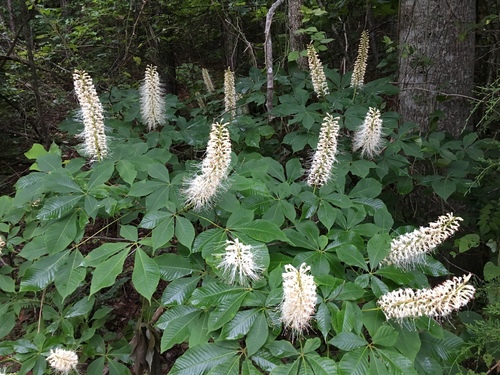
Aesculus parviflora Walter, commonly called small-flowered buckeye, grows to 2–4 meters tall. Its leaves are arranged in opposite pairs, and are palmately compound with 5 to 7 leaflets. Each leaflet is short-stalked, measures 12–22 cm long and 5–10 cm broad, and has an entire margin. The plant produces flowers in noticeable upright panicles 20–50 cm long that have a shape similar to a traditional bottle brush. Each flower has a tubular calyx, small white petals, and several protruding stamens 3–4 cm long. After flowering, the plant develops pear-shaped capsules that hold polished, brown seeds. The Latin specific epithet parviflora translates to "small-flowered". Aesculus parviflora is cultivated as an ornamental plant for gardens, where its August blooming attracts butterflies. It grows best in moist, well-drained soils, and thrives in part shade to full shade. In the United States, it is suited to USDA hardiness zones 4 through 8. American naturalist, explorer, and plant collector William Bartram was the first to record this then-undescribed shrub during his travels through Carolina, Georgia, and Florida between 1773 and 1778. As of 1930, a mature established specimen of the species still grew in Bartram's Garden in Philadelphia. The species was introduced to British horticulture by John Fraser, who first conducted botanizing expeditions in the American South in 1785. The plants Fraser collected were distributed to English nursery businesses including Lee and Kennedy and Loddiges, as well as to private patrons. By 1820, the shrub was recorded as being available from most English nurseries. This plant has been awarded the Royal Horticultural Society's Award of Garden Merit.