About Aesculus glabra Willd.
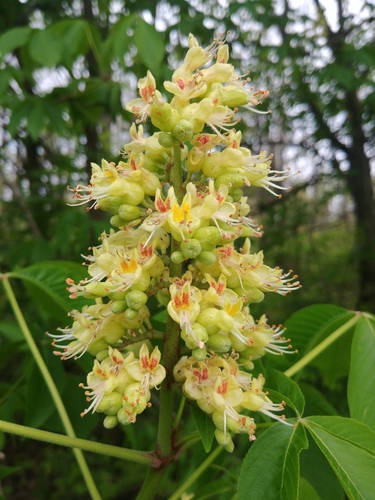
Aesculus glabra Willd. has palmately compound leaves, each bearing five leaflets that are 8 to 16 cm (3 to 6 1⁄2 inches) long and wide. In spring, it produces flowers in panicles; the flowers are red, yellow, or yellow-green, and measure 2–3 cm (3⁄4–1 1⁄4 inches) long. Unlike the related yellow buckeye, its stamens are longer than its petals. The fruit is a round capsule 4 to 5 cm (1 1⁄2 to 2 inches) in diameter, which holds a single nut-like seed 2 to 3 cm (3⁄4 to 1 1⁄4 inches) in diameter. The seed is brown with a whitish scar at its base. The seeds of Aesculus glabra are inedible, contain tannic acid, and are poisonous to both cattle and humans. Young foliage, young shoots, and bark are also poisonous to some extent. Reports note that Native Americans ate the buckeye fruit after boiling it to remove tannin. As a timber tree, Aesculus glabra has very little use because its wood is soft and light. While it is occasionally grown in cultivation, its large, abundantly produced fruits generally make it an undesirable choice for a street tree. Extracts from Aesculus glabra have demonstrated anti-cancer properties.