About Aeschynomene americana L.
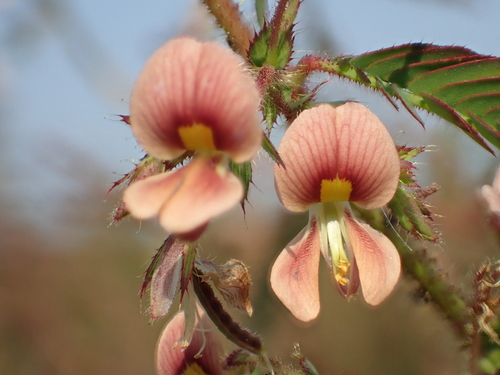
Aeschynomene americana L. is a flowering plant species in the legume family Fabaceae. It goes by a wide range of common names across different regions, including shyleaf, forage aeschynomene, American joint vetch (used in the United States and Australia), thornless mimosa (used in Sri Lanka), bastard sensitive plant (used in Jamaica), and pega pega, pega ropa, antejuela, ronte, cujicillo, and dormilona (used in Latin America). It is native to Central America, parts of South America, the West Indies, and Florida. Today, it can also be found growing in the rest of the United States, Australia, and Southeast Asia. This plant is an annual or perennial herb that reaches up to 2 meters in height. Its leaves grow up to 7 centimeters long, and each leaf bears several pairs of linear to oblong leaflets. These leaves are sensitive and fold up when touched. The inflorescence is a raceme, with individual flowers growing up to one centimeter long. Flowers can be white, pinkish, orange, or purplish in color. The fruit is a curved legume pod that grows up to 4 centimeters long, divided into several jointed units that each hold one seed. This species is widely grown as green manure or a pasture plant throughout the tropical world. Livestock graze it, and it can also be cut to make hay. Cattle readily eat this plant, and spread its seeds on their coats and in their manure. One available cultivated variety is 'Glenn'. In the wild, Aeschynomene americana is typically a wetland plant that easily establishes in wet areas such as drainage ditches. Deer graze on the wild plant, and wild birds eat its seeds.