About Aerodramus brevirostris (Horsfield, 1840)
Size
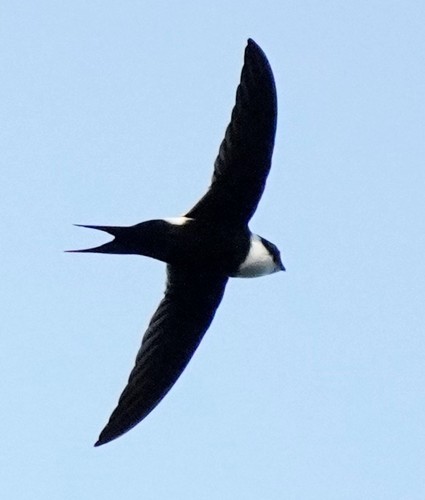
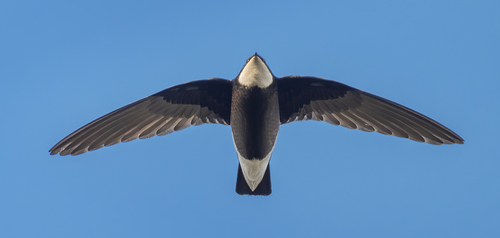
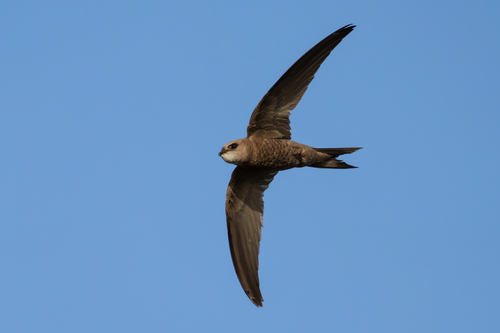
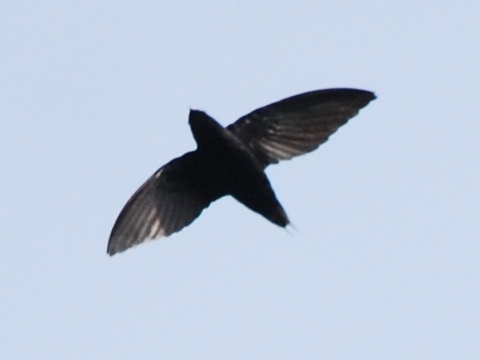
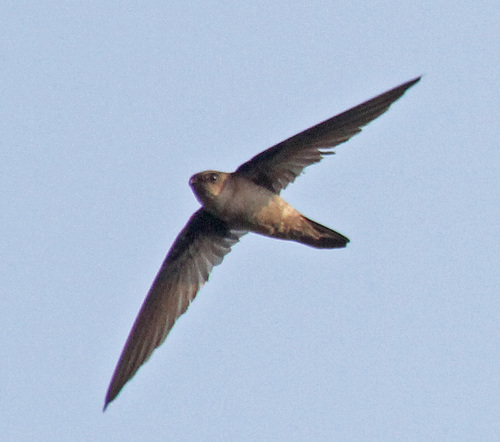
This 13 to 14 centimeter long swiftlet has swept-back wings shaped like a crescent or a boomerang.
Body & Tail Shape
It has a slender body and a forked tail.
Flight Adaptations
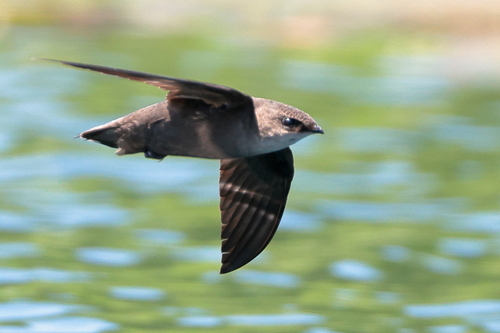
Like most typical swifts, it has narrow wings built for fast flight, plus a wide gape, a small beak surrounded by bristles, all adapted to catch insects mid-flight.
Leg Characteristics
Its legs are very short: this prevents the bird from perching, but lets it cling to vertical surfaces.
Plumage Main Coloration
Its upperparts are mainly grey-brown, while its underparts are paler brown.
Facial & Rump Markings
It has a pale grey rump and a pale patch above and behind its bill.
Age & Sex Plumage Differences
The sexes look similar, but juveniles have a less distinct pale rump.
Subspecies Variation Overview
There are five subspecies, which differ mostly in the tone of their rumps.
Nominate Subspecies Range
The nominate subspecies, A. b. brevirostris, breeds across the Himalayas eastward to Bangladesh, Myanmar, and Thailand.
Nominate Subspecies Migration
It is an altitudinal migrant: it breeds at elevations up to above 4,500 meters, and winters at elevations between 900 and 2750 meters.
A. b. innominata Range & Rump Trait
A. b. innominata breeds in central China and winters in southwestern Thailand and the Malay Peninsula; its rump is slightly darker grey than that of the nominate A. b. brevirostris.
A. b. inopina Range & Rump Trait
A. b. inopina breeds in southwestern China, and it is the darkest-rumped subspecies.
A. b. rogersi Details
A. b. rogersi, also called the Indochinese swiftlet, breeds in eastern Myanmar, western Thailand, and Laos; it is a small subspecies with a pale rump.
A. b. vulcanorum Range
A. b. vulcanorum, also called the volcano swiftlet, breeds on volcanic peaks in Java, Indonesia.
A. b. vulcanorum Plumage
It has dark underparts and an indistinct pale grey rump.
Regional Distinctiveness
Across most of this species' range, it is the only swift species present.
Identification Challenges
However, in the southern part of its breeding range and across most of its wintering range, it can be very hard to tell this species apart from other Collocalia swiftlets.