About Aelurillus dubatolovi Azarkina, 2003
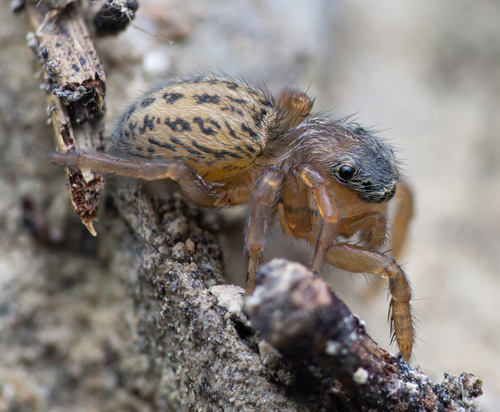
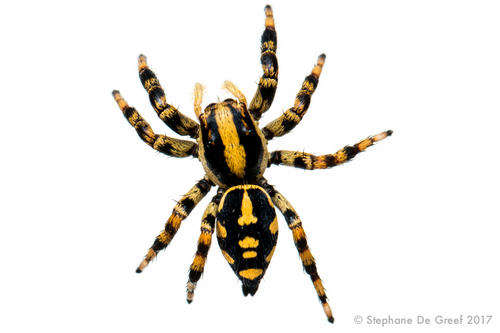
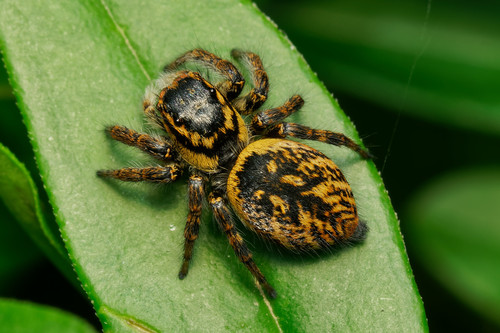
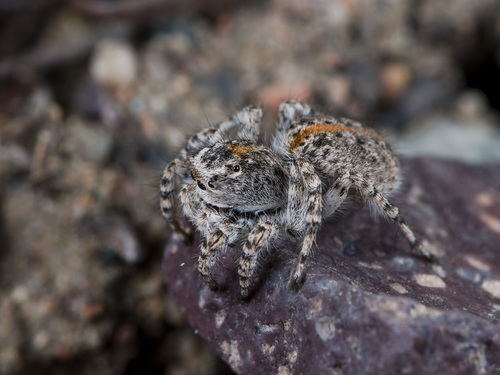
Aelurillus dubatolovi is a small spider with a two-part body: a forward cephalothorax and a rear abdomen. Males have a dark brown carapace (the hard upper shell of the cephalothorax) that is typically 3.1 mm long, 2.2 mm wide, and 1.6 mm high. The carapace is covered in dark brown and white scales, with long dark hairs along its sides. The spider’s eye field is black, and some eyes are surrounded by white hairs. White hairs also cover the brown clypeus (cheeks). The chelicerae are yellow-brown. Males have a yellowish-grey abdomen that is 2.9 mm long and 1.9 mm wide, and neither the abdomen nor carapace have any markings. The book lung covers and spinnerets are grey-yellow, while the legs are yellow-brown, with some legs bearing two yellow stripes. The femur of the male copulatory palpal organs is covered in greyish or brownish hairs. The palpal bulb is large, with a pointed embolus that curves 180 degrees. Embolus length varies: individuals from the northeastern part of the species range have longer, more curved emboli. At the opposite end of the palpal bulb there is a large, pointed, curved projection, and the palpal tibia has a blunt apophysis (projection).
Females are slightly larger than males. Like males, they have a dark brown carapace, which measures 3.6 mm long and 2.5 mm wide, and is covered in black and white scales. Their chelicerae and clypeus are brown, matching the male, and covered in white hairs. The abdomen is grey with a net-like pattern, and measures 4.1 mm long and 3.2 mm wide. The book lung covers are yellow-grey, the spinnerets are more brown in colour, and the legs do not have the stripes seen on males, instead bearing dark patches. The female pedipalps are brownish. The epigyne has a central pocket and closely aligned copulatory openings, the spermathecae are long and complexly curved, and the palpal femora are hairy with a distinctive outgrowth. Apart from their copulatory organs, females are hard to distinguish from other species in the genus.
Aelurillus dubatolovi is similar to other species in the Aelurillus genus. It is particularly similar to Aelurillus ater, and differs from this species mainly by having hairs on the clypeus and palpal femora. It can also be confused with Aelurillus lutosus, which does not have the hairy carapace sides that mark Aelurillus dubatolovi. It differs from Aelurillus brutus by the lack of a pattern on the underside of the abdomen, and by the length of the hairs that line the carapace. As is common for this genus, females are especially hard to distinguish from other species.
The species is distributed across Central Asia, ranging from the Caspian Sea to Lake Balkhash. Its holotype was collected by Vladimir Dubatolov in 1991 in Köýtendag Nature Reserve, Turkmenistan, at an altitude between 1,800 and 2,500 m above sea level. It has also been found in Tajikistan, specifically in the Karateginskiy and Mogoltau Mountains. Specimens have been recorded in many areas of Kazakhstan, including the Karatau Mountains, and the Betpak-Dala and Moiynkum Deserts, showing the wide range of habitats the species can live in. Specimens collected in 1983 and 1986 near Chong-Aryk in Kyrgyzstan have also been identified as this species. It has additionally been found in the area around Tashkent, on the banks of the Angren River in Uzbekistan, and in Uzbekistan’s Surxondaryo Region, which borders both Tajikistan and Turkmenistan. Individuals across the range vary: those in the southwest are larger, hairier, and darker, while individuals from the northeast have more distinct colour patterns. Despite these differences, other shared traits led Azarkina to classify all these populations as the same species.