About Aegypius monachus (Linnaeus, 1766)
The cinereous vulture (Aegypius monachus) has a total length of 98–120 cm (39–47 in) and a wingspan of 2.5–3.1 m (8 ft 2 in – 10 ft 2 in). Males weigh 6.3 to 11.5 kg (14 to 25 lb), while females weigh 7.5 to 14 kg (17 to 31 lb). It is the largest accipitrid, and is therefore counted among the world’s heaviest flying birds. Average weights for this species were not published until recently; median weights from two earlier sources were 9.42 kg (20.8 lb) and 9.55 kg (21.1 lb). A large survey of wild cinereous vultures conducted in Korea recorded an average weight of 9.6 kg (21 lb) and a mean total length of 113 cm (44 in). This study is the only effort to measure average sizes of free-flying mature cinereous vultures, rather than nestlings or captive individuals. Unlike most accipitrids, male and female size overlap broadly, though females are still often slightly heavier. The cinereous vulture is one of the two largest extant Old World vultures and accipitrids. The Himalayan vulture (Gyps himalayensis) has been recorded with similar total length and possibly similar wingspans, and has broadly similar wing and tail proportions, but the cinereous vulture is slightly heavier, and also slightly larger in tarsus and bill length. Superficially similar, but only distantly related New World condors may have similar wing area and body bulk, or may be slightly larger in these traits. Despite limited genetic variation within the species, body size increases from west to east based on standard measurements. Birds from southwest Europe (Spain and southern France) average roughly 10% smaller than those from central Asia (Manchuria, Mongolia and northern China). Standard measurements for the species are: wing chord 73–89 cm (29–35 in), tail 33–41 cm (13–16 in), and tarsus 12–14.6 cm (4.7–5.7 in).
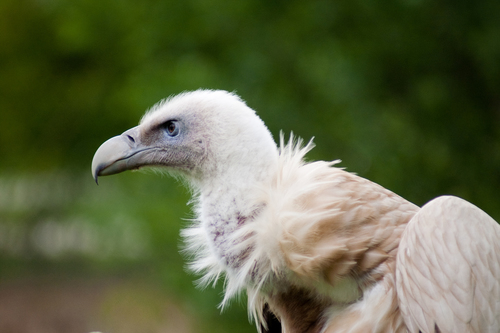
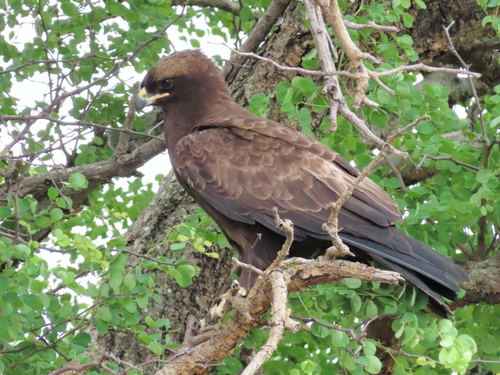
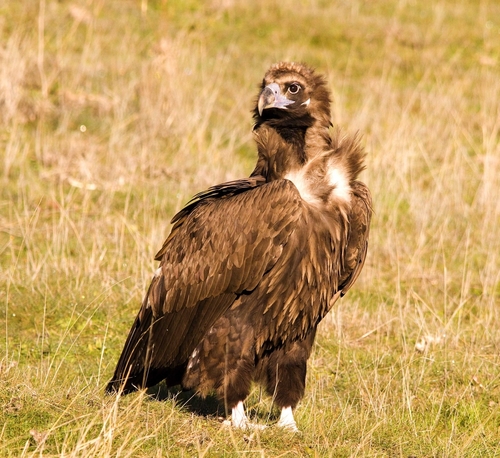
The cinereous vulture has a distinct dark overall coloration. Its entire body is dark blackish-brown, except for the pale head of adult individuals, which is covered in fine blackish down. This fine down is not present on the closely related lappet-faced vulture (Torgos tracheliotos). The skin of the head and neck is bluish-grey, and is a paler whitish shade above the eye. Adult cinereous vultures have brown eyes, a purplish cere, a blue-grey bill, and pale blue-grey legs. The primary quills are almost always solid black. When flying at a distance, the bird can easily appear entirely black. Immature birds have sepia-brown plumage on their upperparts, and a much paler underside than adult birds. Immatures also have grey down on the head, a pale mauve cere, and grey legs. The cinereous vulture has a massive bill, one of the largest of any living accipitrid, a trait made more prominent by the species’ relatively small skull. The exposed culmen measures 8–9 cm (3.1–3.5 in). Only the related lappet-faced vulture can rival or exceed the cinereous vulture’s bill size, reaching up to around 10 cm (3.9 in) in bill length. In flight, the broad wings have serrated leading edges and are held straight or slightly arched; they are sometimes described as "barn door wings". Flight is slow and buoyant, with deep, heavy flaps when required. The combination of the species’ huge size and dark coloration makes it fairly easy to distinguish, especially when compared to smaller raptors such as eagles or buzzards. The lappet-faced vulture, which has the most similar body shape and may have limited range overlap with the cinereous vulture in the southern Middle East, can be told apart by its bare, pinkish head and contrasting plumage. Adult lappet-faced vultures have whitish thighs and bellies, contrasting with black to brownish plumage on the rest of the body. All Gyps vultures that could be confused with the cinereous vulture are distinguished by their paler, often streaky plumage, and bulging wing primaries that give them a less evenly broad wing shape. Cinereous vultures are generally very silent; they only produce soft mewing, roaring or guttural calls between adults and their offspring at the nest site.
The cinereous vulture is a Eurasian species. The western edge of its range reaches Spain and inland Portugal, with a reintroduced population in southern France. Its distribution is discontinuous through Greece, Turkey, and across the central Middle East, continuing east through Afghanistan to northern India, before reaching its eastern range limit in central Asia, where it breeds in northern Manchuria, Mongolia and Korea. Its range is heavily fragmented, especially across its European extent. It is generally a permanent resident, except in parts of its range where harsh winters cause limited altitudinal movement, and for juveniles once they reach breeding maturity. At the eastern edge of the range, birds from the northernmost areas may migrate south to southern Korea and China. Limited migration has also been recorded in the Middle East, but it is not common.
This vulture inhabits hilly, mountainous areas, and across most of its range it especially favors dry semi-open habitats such as high-altitude meadows. Nests are usually located near the tree line in the mountains. The species is always found in undisturbed, remote areas with little human activity. It forages for carrion across many different terrain types, including steppe, other grasslands, open woodlands, along riparian habitats, and any gradient of mountainous habitat. In its current European range, and across the Caucasus and Middle East, cinereous vultures occur at elevations from 100 to 2,000 m (330 to 6,560 ft), while in Asia they typically live at higher elevations. Two habitat types are preferred by the species in China and Tibet: some individuals live in mountainous forests and shrubland between 800 and 3,800 m (2,600 to 12,500 ft), while others favor arid or semi-arid alpine meadows and grasslands at elevations from 3,800 to 4,500 m (12,500 to 14,800 ft). This species is capable of flying at very high altitudes; one cinereous vulture was sighted at 6,970 m (22,870 ft) on Mount Everest. It has a specialized high oxygen-affinity hemoglobin alphaD subunit, which lets it take up oxygen efficiently despite the low partial pressure in the upper troposphere.