About Aegolius harrisii (Cassin, 1849)
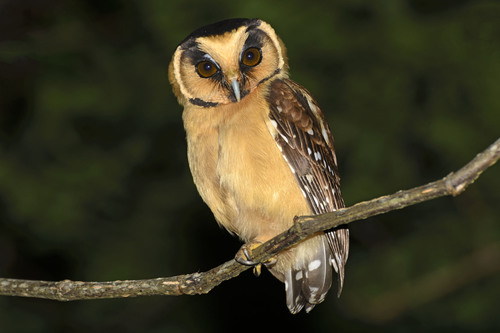
The buff-fronted owl (Aegolius harrisii, first described by Cassin in 1849) measures 19 to 21 cm (7.5 to 8.3 in) in length and weighs 104 to 155 g (3.7 to 5.5 oz). It has a compact body, a short tail, and a large blocky head that lacks ear tufts. Its facial disks are buff, outlined with a black border, and marked by distinctive black patches above its greenish yellow eyes. For the nominate subspecies, the forehead and hindneck are yellowish buff, while the rest of the head and upperparts are chocolate brown. The tail is blackish, with two white bars and a white tip. A small brown patch marks its chin, and the remainder of its underparts are yellowish buff. Subspecies A. h. dabbenei has darker upperparts and a cinnamon tinge to its underparts; A. h. iheringi also has darker upperparts, and its underparts are a deeper orange. The nominate subspecies occurs in a discontinuous range along the Andes from Venezuela south to southern Peru. A. h. iheringi also has a discontinuous distribution, found in Bolivia, Paraguay, eastern Brazil, southern Brazil, northeastern Argentina, and northeastern Paraguay. A. h. dabbenei occurs in northwestern Argentina, and birds observed in western Bolivia may also belong to this subspecies. It is unknown which subspecies the local populations of buff-fronted owls on the tepuis of southern Venezuela and Guyana belong to. The buff-fronted owl lives in a range of landscapes, including open humid forest, dry forest, forest edges, subtropical rainforest, and human-altered areas that have fruit trees and palms. In the Andes, it occurs at elevations between 1,500 and 3,800 m (4,900 and 12,500 ft); in other areas, it occurs between approximately 600 and 1,000 m (2,000 and 3,300 ft).