About Aegialitis annulata R.Br.
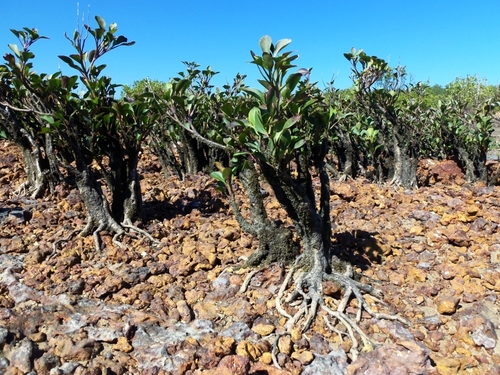
Aegialitis annulata R.Br. is one of only two species in the Aegialitis genus, whose members are woody mangrove shrubs or small trees that reach 2 to 3 m in height. These deciduous plants have leafy stems that bear leathery leaves arranged alternately or spirally. Their leaf margins are entire, and their leaves have parallel veins. The genus's hermaphroditic flowers are pollinated by Hymenoptera, Lepidoptera, and Diptera. Flowers are arranged in terminal cymose racemous inflorescences. Each individual flower has five sepals arranged in a fused tube that surrounds a white gamopetalous corolla; the corolla has five petals fused into a short tube. The androecium is made up of five stamens attached near the base of the corolla tube. The superior gynoecium has five carpels, each with a 1-celled pistil and unilocular ovaries. Fruits of these species are dehiscent and have a spongy mesocarp. Unlike most other mangrove species, Aegialitis members generally do not grow aerial roots. Both species in the Aegialitis genus are native to Southeast Asia and Australia, but their distribution ranges do not overlap. A. annulata occurs along the northern coasts of Australia, from Western Australia through the Northern Territory into Queensland, and along the coastline of Papua New Guinea. The other Aegialitis species, A. rotundifolia, grows on the shorelines of the Andaman Sea and the Bay of Bengal, ranging from Orissa to Mergui, and also occurs on the Andaman Islands. The distribution of these two Aegialitis species, relative to other members of the Plumbaginaceae family, provides clues about the evolutionary history and phylogenetic placement of the Aegialitis genus. Multiple authors have found evidence for three distinct southern migrations of this mostly Northern Hemisphere family. The first of these migrations remained isolated and evolved into the modern species of the Aegialitis genus. This hypothesized migration and evolutionary history explains why the genus has more primitive breeding system characteristics and morphology compared to the rest of the Plumbaginaceae family. Like other mangrove species, Aegialitis members prefer habitats with sandy or rocky soils in the more saline, seaward portions of mangrove ecosystems, so the species are classified as halophytic.