About Adoxa moschatellina L.
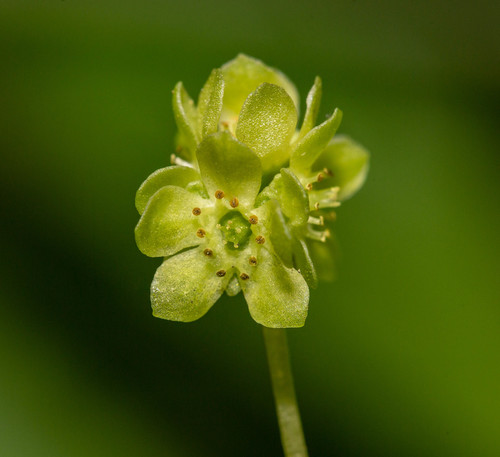
Adoxa moschatellina, commonly known as moschatel, is a patch-forming perennial herb that grows 10–15 cm (4–6 in) tall, with pale green foliage and a delicate overall appearance. It spreads via swollen, fleshy rhizomes and long, slender stolons. Aerial stems emerge in early spring, typically around the end of February in England, long before tree canopies close in deciduous woodlands. These stems are slender, erect, unbranched, and entirely glabrous (hairless), with no stipules present. Most plants produce two basal leaves on long petioles that are almost as long as the stem, plus two opposite leaves near the top of the stem on short petioles that widen toward the base. Basal leaves are dull green on the upper surface, silvery and succulent on the lower surface, and bear stomata only on the underside; they are divided into three lobes (ternate) or twice ternate, growing up to 5 cm (2 in) long. Stem leaves have 2 or 3 lobes, with leaf blades reaching up to 3 cm (1.2 in) in length. At the top of the stem, an inflorescence sits on a peduncle that is at least as long as the stem when flowering occurs. This inflorescence is unique and highly distinctive to the genus Adoxa: it forms a cubical cluster of 5 green flowers, each roughly 0.5 cm in diameter. Four of the flowers, with 5 petals each, sit on the sides of the cube, while a single 4-petalled flower grows at the top of the cluster. The flowers are reported to have a faint musky scent, particularly towards the evening when dew forms. Lateral flowers each have 5 stamens that are deeply divided, giving the appearance of 10 stamens total, and 2–5 styles. The terminal flower has only 4 similarly divided stamens. Below the corolla, the calyx has 3 lobes on lateral flowers and just 2 lobes on the terminal flower. Fruits develop between April and May in England; each flower can produce 2–5 fruits, which are dry drupes measuring 4.5–5.55 mm in diameter, and are partially enclosed by the expanded, fleshy calyx. After fruiting, the peduncle expands, twists into a spiral, and bends toward the ground to deposit the fruits close to the parent plant. Fruiting is uncommon, as moschatel reproduces mainly vegetatively via its stolons and rhizomes. Adoxa moschatellina has a boreal, circumpolar native distribution across Europe, Asia, and North America, and extends just into Morocco in northern Africa. It has not become established as an introduced species outside this natural range, except possibly in Ireland. It is generally not considered rare or threatened: in the United States it is classified as secure, and while the IUCN has not completed a global assessment of the species, many European countries classify it as Least Concern. It is widespread across most of Britain but not common, generally restricted to small patches in ancient woodland. It becomes scarce in northern and western Britain, where soils are too acidic, and in parts of eastern England that have little remaining woodland cover. It is absent from most of Ireland, only occurring in a small number of sites where it was probably introduced either deliberately or accidentally. Moschatel grows in woodland and scrub, typically in areas of fairly light shade such as path edges and alongside streams and rivers. Its Ellenberg values for Britain are L = 4, F = 5, R = 6, N = 5, S = 0, indicating it prefers lower than average light and nutrient levels, and higher than average moisture and alkalinity. It is found in deciduous woodland under ash, pedunculate oak, sessile oak, hornbeam, or beech, most often at the bottom of slopes where soils are damper and more base-rich, growing alongside dog's mercury and wood anemone. Under the British National Vegetation Classification, this habitat corresponds to ash woodland: W8 in lowlands and W9 in uplands. It is also recorded in elder scrub (community W6d) along riverbanks. In the Scottish Highlands and Snowdonia, it grows in juniper scrub (W19), and in shady crevices among boulders in upland heaths and on pillow lavas on Cadair Idris. It is a spring-flowering species that dies back above ground after flowering finishes in May or June. Seeds are deposited very close to the parent plant, which limits the species' ability to spread naturally; this limited seed dispersal helps explain why it is largely restricted to ancient woodland, though it can establish well in new sites if moved there by people. It spreads more effectively via rhizomes and stolons than via seed. In Scotland, it has been recorded growing as high as 1,065 m (3,494 ft) on Ben Lawers, and in England it reaches up to 760 m (2,490 ft) at Knock Fell. Its plain green flowers are pollinated by flies and nocturnal moths, which do not rely on flower colour to locate plants. Insect associations with moschatel are generally rare. In Britain, the larvae of two sawfly species are known to feed on this plant: Paracharactus gracilicornis (Zaddach, 1859) and Sciapteryx consobrina (Klug, 1816). Across Europe, moschatel is commonly infected by the rust fungus Puccinia adoxae R. Hedw., which produces small black telia (blisters) on the plant's stems and leaves. Puccinia albescens (Grev.) Plowr. and P. argentata (Schultz) G. Winter (synonym P. impatientis) form whitish galls along with black telia. More rarely, moschatel can be parasitized by Melanotaenium adoxae, which produces yellow-white blisters.