About Adonidia merrillii (Becc.) Becc.
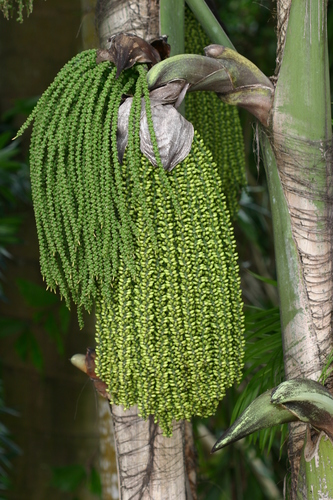
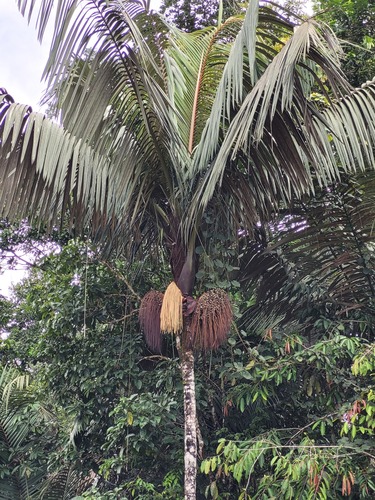
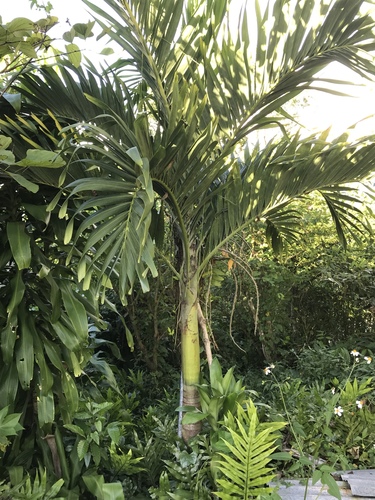
Adonidia merrillii, commonly called the Manila palm or Christmas palm, is a species of palm tree endemic to the Philippines, where it is native only to Palawan and Danjugan Island. It had been cultivated in the Philippines for centuries before it became a widely used landscape plant in the West. It is currently reported to be naturalized in the West Indies and Florida. It gets the common name "Christmas palm" from its bright scarlet fruits, which typically retain this color through the winter months. This palm is usually fairly small and slender; it normally reaches 25 feet (8 meters) in height, though some individuals have grown to over 40 feet. Young plants usually keep 5 to 7 fronds, and the crown gradually adds more fronds as the palm ages. Mature palms can sometimes develop 10 to 12 fronds in their crown.
Sometimes referred to as the "miniature royal palm", Adonidia merrillii adapts well to landscaping, general cultivation, and container growing in pots. It can tolerate heavy rainfall and short periods of drought, but it is not tolerant of sea salt. It prefers full sun but can also grow well in partial shade. It cannot tolerate cold temperatures, so it can only be grown as a perennial outdoors in frost-free areas. It is one of the most common landscape palms in Southern Florida, including planted at venues like the Miami Open tennis tournament. It is often planted in clustered groups of 2 to 3, and sometimes 4, individual palms. Since this species naturally grows as a solitary palm, clustering multiple trunks together creates a risk of competition between the individual plants. To reduce this risk, nurseries train young palms to grow outward in an arch rather than growing straight upward. Adonidia merrillii is widely planted in cultivation, and grows well in tropical locations such as Hawaii and the southern half of the Florida peninsula. It is also one of the most commonly planted ornamental palms across the world, and is often used in non-tropical locations such as indoor shopping malls. In regions that experience freezing winter temperatures, it is sometimes grown as an annual for the warm season; one example is the plantings used in Times Square, New York City, during warm months. It is also commonly placed indoors in higher-end establishments like hotels and casinos, because it adapts well to lower light conditions. It is a self-pruning palm that requires little to no maintenance. Its fruits are sometimes reported to be used as a substitute for betel nut when preparing buyo, the chewed preparation made from Areca catechu fruit, Piper betle leaves, and lime.