About Adiantum trapeziforme L.
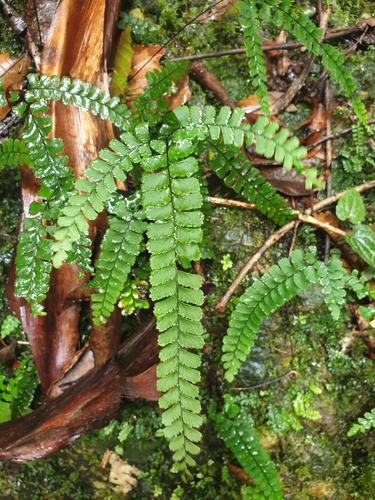
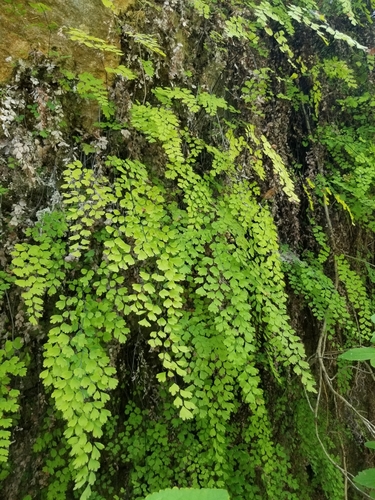
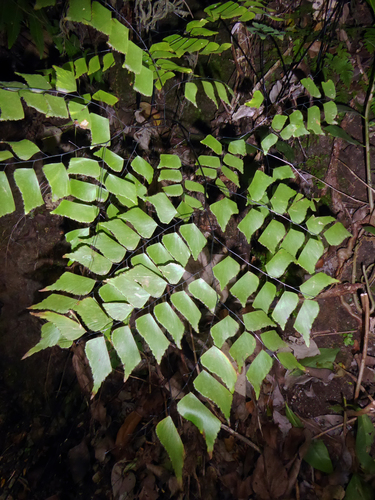
Maidenhair ferns, all species in the genus Adiantum, grow on the ground and on rocks. Species in this genus are primarily identified by a consistent key feature: their spore-producing sporangia form along one side of the pinnule, which is the smallest division of a compound leaf. The sporangia are held within structures made from folded-under flaps of the pinnule margin, called "false indusia," and these false indusia are separate from one another. Out of roughly 245 accepted Adiantum species, Adiantum trapeziforme L. has additional distinguishing traits: its leaf blades are 2 to 4 times pinnately divided. The final segments, called pinnules, are relatively large, reaching up to 5 cm long and 2 cm across (about 2 by 3/4 inches). The pinnules most often have a trapeziform shape. The blade stipes are dark purple to blackish, shiny, hairless, and measure almost half the length of the entire blade; the rachis, which is the extension of the stipe into the blade, is dark purple. Adiantum trapeziforme is native to regions including parts of Mexico, Cuba, Jamaica, the Lesser Antilles, extending south through Central America to Trinidad, and possibly Venezuela. It has been documented as an introduced species in India, Sri Lanka, and the U.S. state of Florida. Citizen scientists contributing to iNaturalist have also recorded observations of this species in other locations, most notably Indonesia and Oceania. This fern grows in wet forests and secondary forests, at elevations ranging from lowlands up to 1000 meters (about 3300 feet). Documented traditional uses of Adiantum trapeziforme include treating snakebite, preventing girls from being bothered while walking along roads, and using its fronds for decoration.