About Adenostoma fasciculatum Hook. & Arn.
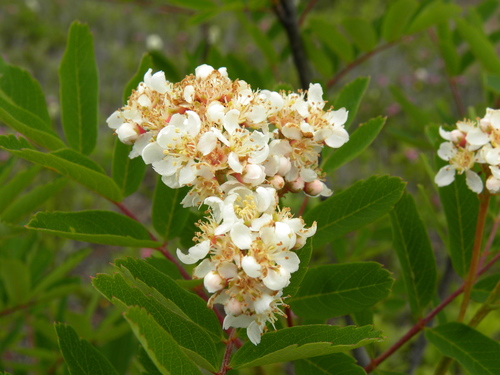
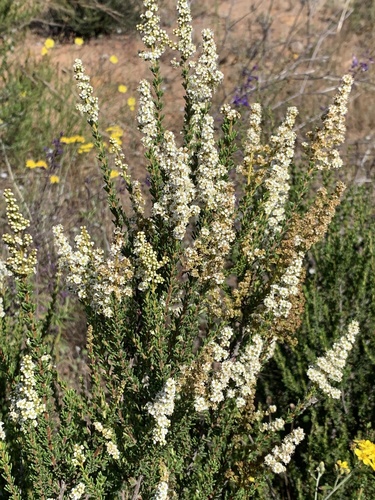
Adenostoma fasciculatum Hook. & Arn., commonly called chamise, is a shrub that typically grows less than 4 meters tall. It has long, arching stems covered in brown to gray bark, with a diffusely branched spreading growth habit; some forms grow prostrate. The numerous slender stems are generally erect and usually lack permanent branches. Young stems have reddish bark, which ages to gray exfoliating bark. Stems are resinous and oily, ranging from glabrous to puberulent, and bear stipules smaller than 1.5 mm. Alternate spirally arranged leaves, and sometimes additional branches, grow from the stems. The leaves are linear and needle-shaped, usually 5 to 10 mm long, nearly round in cross section, and end in a sharp, apiculate tip. They are evergreen and heavily sclerified, and may also grow in a sickle shape. Its inflorescence ranges from dense to open, grows up to 17 cm long, and bears 1 to 3 bractlets. Flowers grow on short pedicels that measure 0 to 1.1 mm long. The small white flowers are inconspicuous yet still showy; they have 5 petals and 5 alternately arranged calyx lobes surrounding the corolla, and the calyx lobes are wider than they are long. The 10 to 15 stamens are held in cylindrical to pyramid-shaped panicles at the tips of branches, where terminal flower clusters measure 2.5 to 10 cm long. Petals are retained through fruit maturation, turning a rusty brown color. The hypanthium is 0.8 to 3.2 mm in size and strongly 10-ribbed. The fruit is a small ovoid achene that develops inside the hypanthium, and disperses as a single unit with the hypanthium.
Chamise is likely the most widely distributed shrub of the chaparral ecosystem in North America, found across California and Baja California. In California, it occurs from Mendocino County south to San Diego County, and is present in approximately 70% of California chaparral. It grows across a wide range of soils, elevations, latitudes, and distances from the coast, reaching elevations as high as 1,800 meters. In Baja California, it grows in the Peninsular Ranges of the Sierra de Juarez and Sierra de San Pedro Martir, as well as the sky islands of the Sierra de La Asamblea and the Sierra de San Borja in the Central Desert. It is typically found on foothills, coastal mountains, ridges, mesas, and hot, xeric sites. It dominates dry south- and west-facing slopes, and survives in an average temperature range between 0 °C and 38 °C. In the southern Coast Ranges, where average annual rainfall ranges between 400 and 500 mm, chamise grows abundantly on all slopes and exposures, thriving in both deep fertile soils and shallow rocky soils. As precipitation increases moving northward, chamise becomes restricted to poorer soils and drier, exposed sites.
Chamise forms dense, monotypic stands that cover the dry hills of coastal California; these thickets are sometimes called chamissal or chamise chaparral, where toyon, scrub oak, ceanothus, and manzanita may also be co-dominant. It is highly drought tolerant and adaptable, able to grow in nutrient-poor, barren soil and on exposed, dry, rocky outcrops. It can grow in serpentine soils and south-facing slopes, environments that are generally inhospitable to most plants, as well as in slate, sand, clay, and gravel soils. Chaparral habitats experience frequent periodic intense wildfires, and like other chaparral plants, chamise dries out, burns, and recovers quickly to thrive again after fire. It effectively controls erosion: it sprouts from low basal crowns that survive fire, preventing bare post-fire soil from being washed away. Chamise is an important plant for local wildlife. After wildfires, resprouting chamise can provide nearly all of the available forage for area animals. Chamise sprouts are browsed by mule deer and likely rabbits, but may be unpalatable to other mammals. Dusky-footed woodrats store its bark and leaves as food in their nests year-round. Chamise and chamissal stands provide habitat and cover for nesting birds, mule deer, and sensitive wildlife species including the orange-throated whiptail lizard and the California gnatcatcher.
Chamise is used to treat eczema and skin conditions caused by chafing and irritation. Plaque psoriasis does not appear to respond well to chamise treatment, but chamise treatment is reported to improve associated discomfort and dryness. A medicinal balm can be prepared by infusing 50 grams of chamise branches and leaves in 2 liters of extra virgin olive oil for one month. The infused oil is then transferred to a mixing bowl, and 135 grams of beeswax is melted and mixed thoroughly with the oil in a 75°C water bath. The mixture is poured into 35-milliliter containers and left to harden into a balm. The finished balm can be rubbed on with fingertips and applied daily to skin rashes and lesions as needed.