About Adansonia gregorii F.Muell.
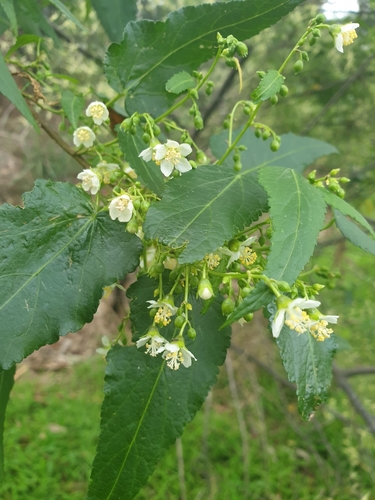
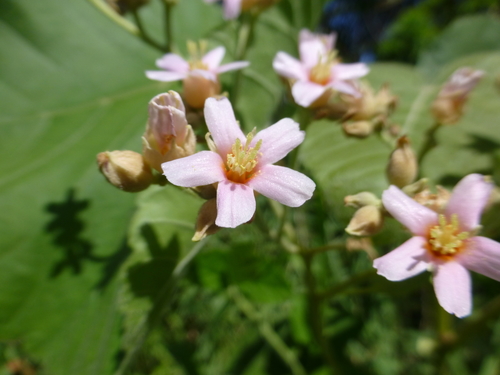
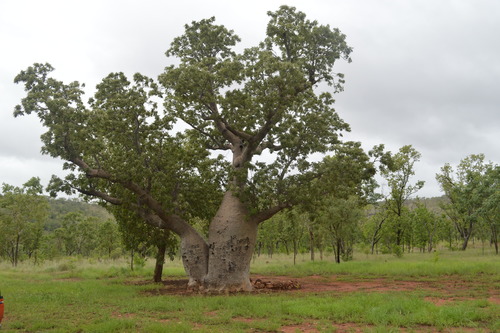
Commonly called boab, Adansonia gregorii F.Muell. is a baobab easily recognized by its swollen trunk base, which forms a massive caudex and gives the tree a distinct bottle-like appearance. Boabs reach a total height of 5 to 15 meters (16 to 49 feet), with most mature individuals growing 9 to 12 meters (30 to 39 feet) tall. Their broad bottle-shaped trunks can grow up to 5 meters (16 feet) in diameter. This species is deciduous: it drops all its leaves during the dry winter season, and produces new leaves and large white flowers between December and May. The flowers can grow up to 75 mm (3.0 in) long, open at night, and have a calyx around 6 cm (2.4 in) long with a densely sericeous inner surface. This species is pollinated by the convolvulus hawk-moth, Agrius convolvuli. The bark of the boab has a notable trait: it preserves inscribed markings for very long periods, over more than a century. While some specimens of the African baobab, a close relative of the boab, have been estimated to live nearly 2,000 years, the maximum lifespan of Australian boabs is not as well documented. Adansonia gregorii is endemic to Australia, and is the only baobab species native to Australia. It grows in the Kimberley region of Western Australia, extending east into the Northern Territory. All other baobab species are native to Madagascar, mainland Africa, and the Arabian Peninsula. Multiple theories exist to explain how baobabs arrived in Australia, as A. gregorii is genetically very similar to its African relative A. digitata. Boabs grow at altitudes from sea level up to around 300 m (980 ft). They are most commonly found in open forest and rocky areas, but also occur in monsoon forest. Boab has a wide range of uses, with most of its parts edible and the tree providing many useful materials. People have exploited its medicinal properties and its ability to store water through dry seasons. Aboriginal Australians have sourced water from large boabs, which can store huge volumes of water in their trunks; the oldest and largest specimens can hold more than 100,000 liters (22,000 imperial gallons; 26,000 US gallons) of water. Aboriginal Australians also eat the white powdery pith that fills the tree's seed pods, which is described as tasting like sherbet or cream of tartar. People sometimes added decorative paintings or carvings to the outer surface of boab fruit. The bark and leaves are used medicinally, most often for digestive ailments. Fibers from the tree's roots are used to make string. The 1889 reference work Useful Native Plants of Australia records that the dry acidulous pulp of the fruit is eaten, and has an agreeable taste similar to cream of tartar. European people have used boab trees for purposes including letter boxes and jails. Boab leaves have been identified as a potential future food source due to their high iron content. The leaves can be boiled and eaten like spinach, seeds can be ground and used to make a coffee-like beverage, and fermenting the fruit pulp produces a type of beer.