About Actiniopteris radiata (J.Koenig ex Sw.) Link
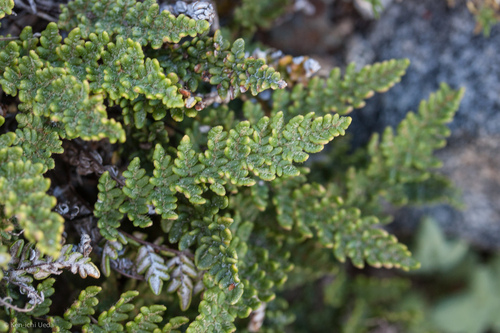
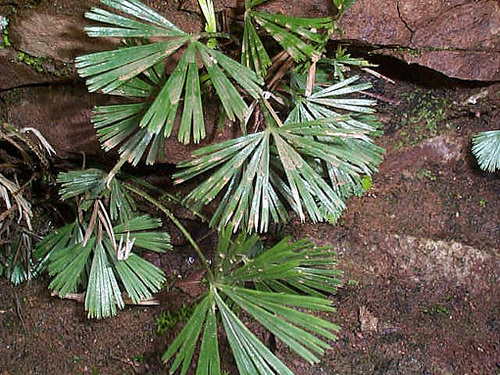
Actiniopteris radiata, whose genus name translates to 'ray fern', is a widely distributed fern. It occurs across Africa and its adjacent islands, as well as in Madagascar, Arabia, Iran, Afghanistan, Nepal, India, Sri Lanka, Burma and Australia. It is very similar in appearance to Actiniopteris dimorpha Pic. Serm. This fern grows in hot, dry habitats, where it can be found at the base of rocks, in rock crevices, and also on deep soil in shady locations. It is common in deciduous woodland that experiences consistently high annual temperatures and low rainfall, and grows at elevations ranging from 500 m to 1300 m. Distinctive fronds grow from a prostrate rhizome, and the fronds are somewhat dimorphic. The laminae are 15–45 mm long, fan-shaped with an approximately 180-degree spread, and the tip of each frond segment bears 2–5 teeth. Tests have found that both aqueous and ethanolic extracts of Actiniopteris radiata have strong analgesic properties and antibacterial activity against Salmonella typhi, Staphylococcus aureus, and Escherichia coli. This species also demonstrates anti-fertility, styptic, anthelmintic, anti-tubercular, and antioxidant properties. Its major known chemical constituents are hentriacontane, hentriacontanol, β-sitosterol, β-sitosterol palmitate, β-sitosterol-D-glucoside, and quercetin-3-rutinoside. In 1992, Botswana released a postage stamp illustrated by Gillian Condy that depicts this fern species.