About Acrotriche cordata (Labill.) R.Br.
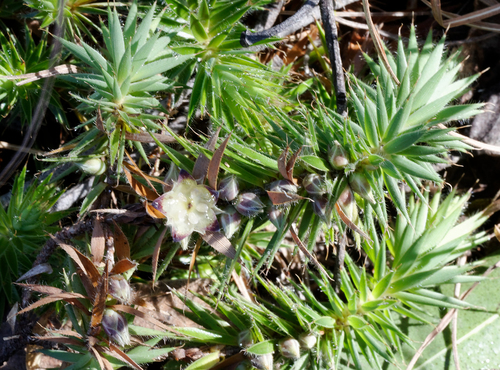
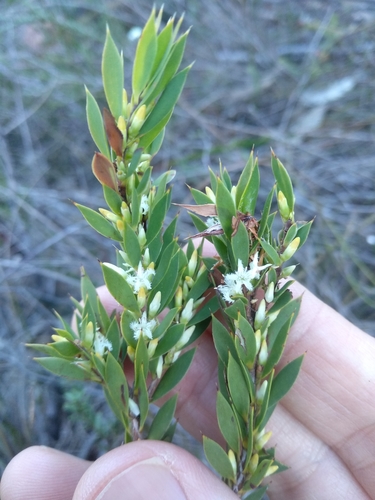
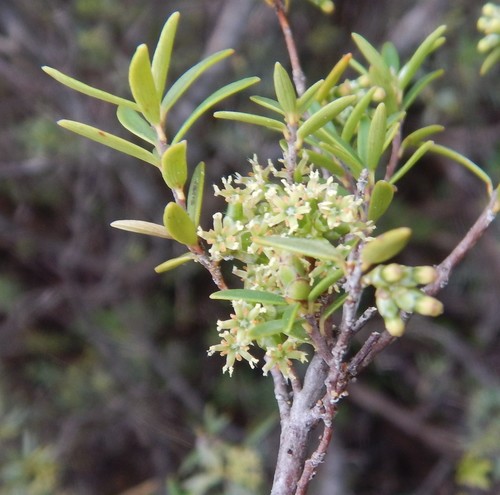
Acrotriche cordata is an erect or spreading shrub that usually reaches about 50 cm (20 in) in height, and has hairy branches. Its leaves are linear, oblong or egg-shaped with sharp points, measuring 4–14 mm (0.16–0.55 in) long and 1.5–4 mm (0.059–0.157 in) wide. The lower leaf surface is slightly paler than the upper surface and bears a few more or less parallel veins.
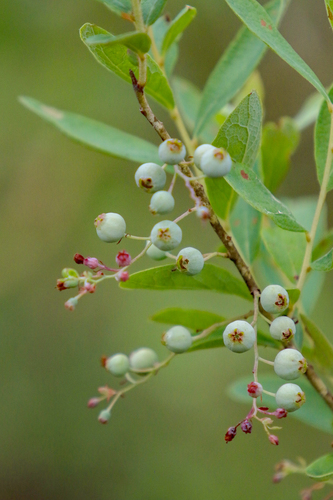
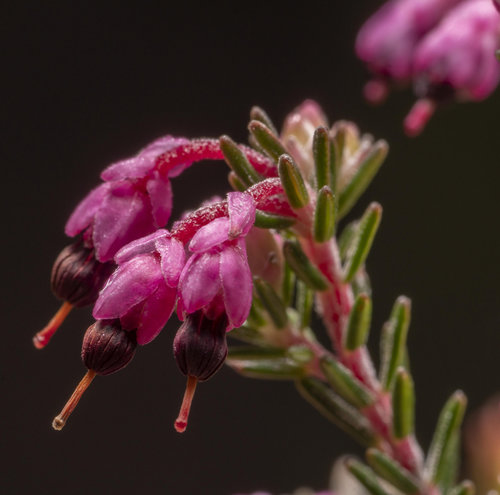
Flowers of this species are arranged in spikes holding 3 to 8 individual flowers, with 1.0–1.2 mm (0.039–0.047 in) long bracteoles at the base of the sepals. The sepals themselves are 1.4–1.9 mm (0.055–0.075 in) long. Petals are joined at the base to form a pale green tube 2.6–3.6 mm (0.10–0.14 in) long, with petal lobes 1.2–1.6 mm (0.047–0.063 in) long. Flowering takes place from July to October, and the fruit that develops is a flattened spherical pale green drupe around 2–3 mm (0.079–0.118 in) long.
Commonly called coast ground-berry, this plant grows on coastal or near-coastal limestone on cliffs and dunes. It occurs in the Esperance Plains, Geraldton Sandplains, Hampton, Jarrah Forest, Mallee, Swan Coastal Plain and Warren regions of Western Australia, and in south-eastern South Australia. It is only found at a small number of sites in Victoria, where it is listed as endangered under the Victorian Government Flora and Fauna Guarantee Act 1988. It also occurs in the Furneaux Group of Tasmania, where it is listed as vulnerable under the Tasmanian Government Threatened Species Protection Act 1995.