About Acrothamnus montanus (R.Br.) Quinn
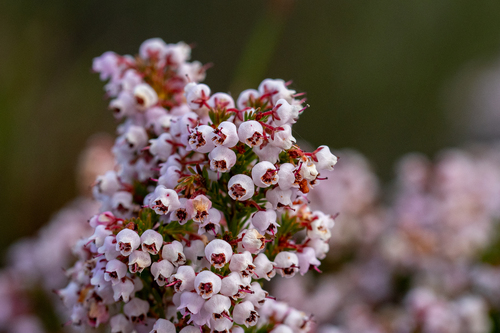
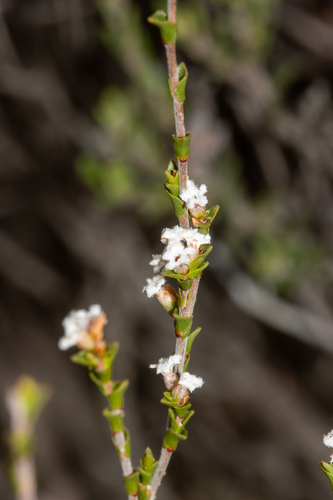
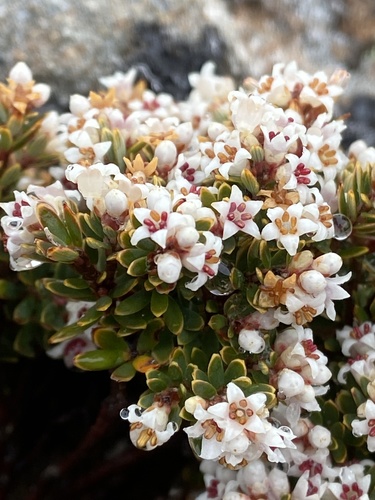
Acrothamnus montanus is a woody perennial shrub that grows up to 50 centimetres (20 in) high. It is a hermaphrodite species that reaches reproductive maturity at around 5 years of age, and typically flowers from December to March, with timing varying by location. Its flower petals are white, glabrous, and bear a few papillae on the inner face. Flowers grow in clusters of approximately 3 to 8 arranged in spikes up to 7 millimetres (0.28 in) long. After flowering, the species produces fleshy drupe fruits that turn red when ripe.
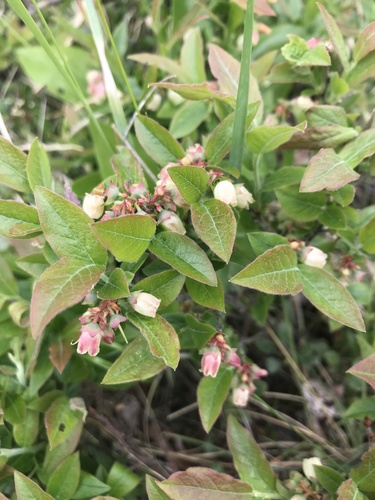
Its leaves are simple, oblong, narrow, and blunt-tipped, with toothed margins; they measure 4.5–7.8 millimetres (0.18–0.31 in) long and 1.2–2.3 millimetres (0.05–0.09 in) wide. The leaf blade (lamina) is glabrous, with a flat or slightly concave upper surface, and a glabrous lower surface marked by three central parallel veins. The petiole is approximately 0.5–1.3 millimetres (0.02–0.05 in) long. A. montanus stores buds in a bud bank located at its base and along its stems. It is easily confused with Acrothamnus hookeri, and is thought to be a clinal form of that species. A. montanus can be distinguished from A. hookeri by the absence of hairs inside its flowers, and its leaves being slightly concave towards the apex.
This species is found in sub-alpine and alpine areas across the Australian states of New South Wales, Victoria, and Tasmania. Under Victorian legislation, specifically the Flora and Fauna Guarantee Act 1988, A. montanus is listed as Endangered (EN). Within Victoria, the species has been recorded in the East Gippsland Uplands, Highlands Northern Fall, Monaro Tablelands, and the Victorian Alps. In New South Wales, it has been found in areas around Mount Stilwell and Mount Kosciuszko.