About Acrothamnus hookeri (Sond.) Quinn
Acrothamnus hookeri is an upright, sometimes bushy shrub that grows to around 50 cm (20 in) tall, with rough branchlets. Its leaves are oblong, measuring 4.0–9.2 mm (0.16–0.36 in) long and 1.1–2.5 mm (0.043–0.098 in) wide. The leaf edges are mostly smooth but have fine teeth near the tip; the upper leaf surface is flat to curved outward, the lower surface sometimes has a whitish coating and bears three roughly parallel central veins, and leaves have a petiole 0.5–1.2 mm (0.020–0.047 in) long.
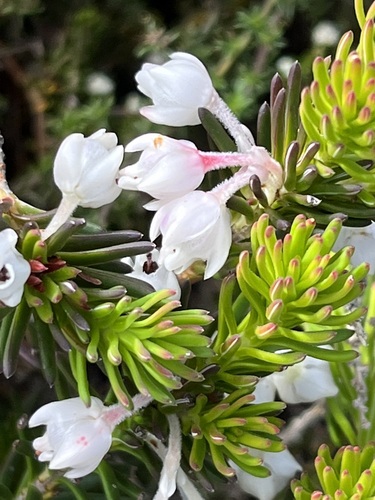
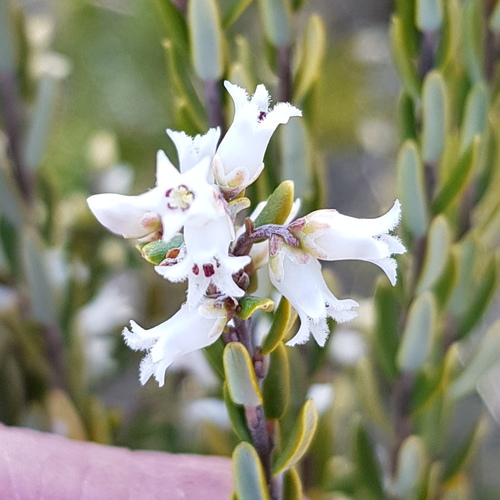
White flowers of this species grow in groups of 1 to 10, arranged in spikes up to 4–10 mm (0.16–0.39 in) long. The flowers are more or less densely packed, borne at the ends of branches or in upper leaf nodes. They have broadly oval bracteoles 1.2–1.7 mm (0.047–0.067 in) long, and sepals 1.75–2.6 mm (0.069–0.102 in) long. The corolla tube is 2–2.1 mm (0.079–0.083 in) long in male plants and 1.8–1.9 mm (0.071–0.075 in) long in female plants; corolla lobes are about 1.5 mm (0.059 in) long and have a beard-like covering of hairs on the inside.
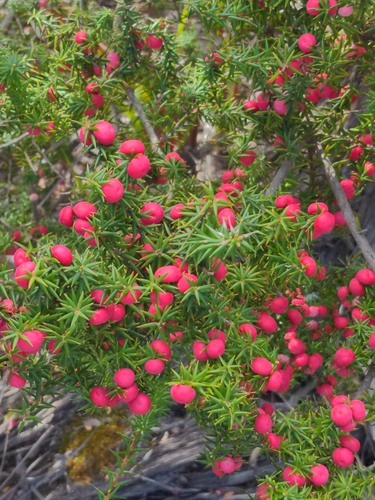
Flowering takes place from October to January. The fruit is a smooth, fleshy pink drupe that turns red when ripe, and is 2.2–2.6 mm (0.087–0.102 in) long. Common name mountain beardheath, this species grows in montane forest, heath on wet rocky soils, and woodland in New South Wales, the Australian Capital Territory and Victoria.