About Acrostichum aureum L.
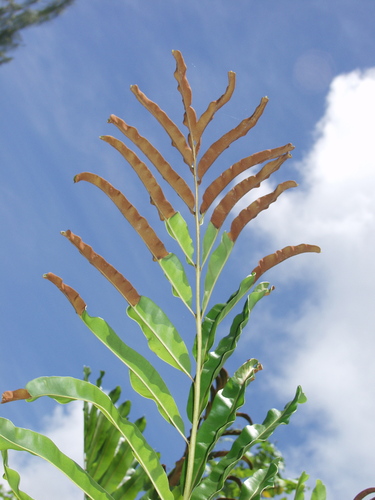
Acrostichum aureum L., commonly called the golden leather fern, produces large fronds that typically grow up to 1.8 metres (six feet) in length. Its leaves are glossy, broad, and pinnate, with dark green, leathery, alternate, widely spaced pinnae. Outer fronds arch sideways, while central fronds are nearly straight. Some larger fronds bear sporangia, the fern’s reproductive organs, on the upper five to eight pairs of pinnae. These sporangia are brick red and give the affected pinnae a felted appearance. The golden leather fern is distributed across tropical and sub-tropical regions worldwide. It grows in swamps, mangrove forests, salt marshes, and on river banks, and it tolerates elevated salinity levels, though its spores germinate better in fresh water. It tends to grow on slight elevations in mangrove swamps that are only occasionally inundated by the sea, and it can also grow in entirely freshwater locations. In Malaysia, two distinct growth forms of this fern exist: larger individuals up to 4 metres (13 ft) tall grow on the periphery of swamps, while much more stunted plants grow in areas that are frequently inundated. It can grow in full sun or deep shade, and the mangrove species Rhizophora mucronata is able to regenerate within dense stands of this fern. While many types of ferns are aquatic, this is the only fern that can grow in the ocean, and is sometimes submerged in it. In Cambodia, this fern is called prâng' tük in the Khmer language, where prâng' means cycad and tük means aquatic, and its young leaves are eaten in salads. In the Indian state of Goa, the fern’s young fiddleheads called crosiers are cooked in a spicy coconut-based gravy known as tonak, and eaten as a local delicacy. For cultivation, golden leather fern can be grown under high light in garden soil or potting mix as long as the growing substrate is kept constantly wet. Ordinary fresh water, not brackish water, is sufficient for its cultivation.