About Acronychia pubescens (F.M.Bailey) C.T.White
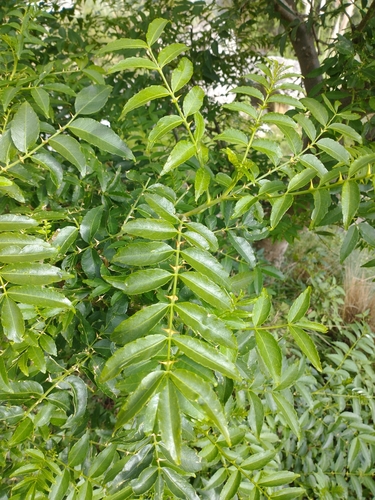
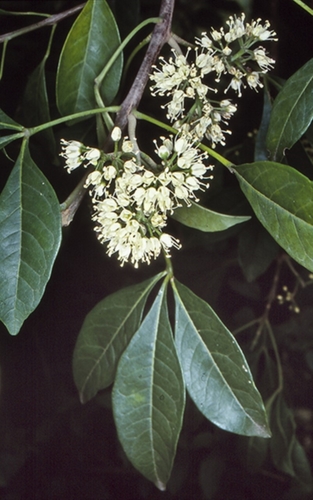
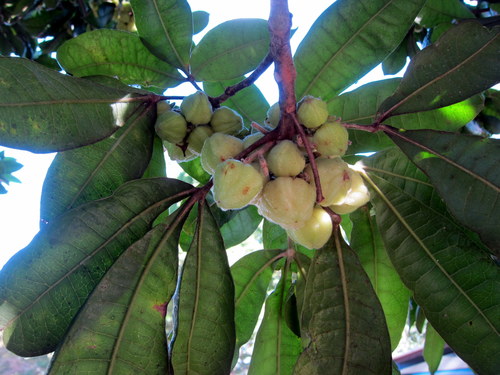
Acronychia pubescens is a species of shrub or tree that typically grows to 15 metres (49 feet) in height, with a stem diameter of up to 18 centimetres (7.1 inches). Its trunk is mostly cylindrical, and it occasionally develops flanges at its base. The bark is greyish brown and relatively smooth, while young small branchlets are golden and covered in downy hair. Its leaves are arranged in opposite pairs; they are usually trifoliate, and rarely simple. Leaflets range in shape from lance-shaped, to elliptical, to egg-shaped, and are 50 to 260 millimetres (2.0 to 10.2 inches) long and 18 to 77 millimetres (0.71 to 3.03 inches) wide. Leaves are borne on a petiole 8 to 85 millimetres (0.31 to 3.35 inches) long, and individual leaflets grow on a petiolule that can be up to 23 millimetres (0.91 inches) long. The upper surface of the leaflets is downy, especially along the midrib, while the lower surface is even hairier. This hairy leaf characteristic distinguishes Acronychia pubescens from other species in its genus. The flowers are arranged in cymes 25 to 65 millimetres (0.98 to 2.56 inches) long, growing in leaf axils. Each flower is borne on a pedicel 1 to 4.5 millimetres (0.039 to 0.177 inches) long. The four sepals are 1.5 to 2.5 millimetres (0.059 to 0.098 inches) wide, the four petals are greenish fawn and 6 to 9 millimetres (0.24 to 0.35 inches) long, and the eight stamens alternate in length. Flowering and fruiting occur in most months of the year. The fruit is a fleshy, hairy, ridged drupe that ranges in shape from elliptical to spherical, and is creamy to yellowish in colour. It is 12 to 18 millimetres (0.47 to 0.71 inches) long, with an acid or turpentine flavour. The fruit contains up to three dark grey or black seeds that are 4 to 4.5 millimetres (0.16 to 0.18 inches) long and shaped like a miniature canoe.
Acronychia pubescens is distributed from Urunga in northern New South Wales to the Blackall Range in south eastern Queensland. It grows in several types of rainforest habitat, including subtropical rainforest on red-brown basaltic soils, littoral rainforest, and riverine rainforest. It is most commonly found in warm temperate rainforest at higher altitudes.
For horticultural use, removal of the fruit flesh from seeds is recommended for successful propagation. Around half of all treated seeds may germinate within seven months. Propagation from cuttings can also be attempted. When grown in cultivation, Acronychia pubescens requires good drainage, and it benefits from extra water and fertiliser. While its fruits are edible, their turpentine flavour makes them somewhat unpalatable.