About Acronychia pedunculata (L.) Miq.
Scientific name: Acronychia pedunculata (L.) Miq.
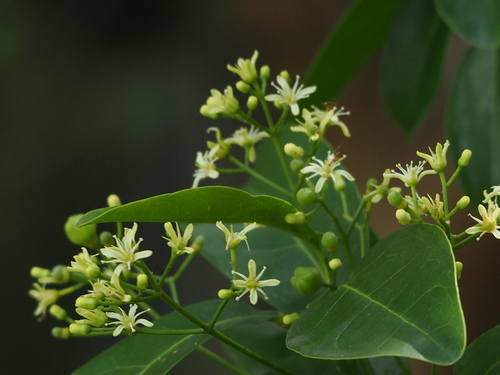
Description: Twigs are more or less angular and glabrous. Leaves are elliptic to suboblong, often with a tapered base. Flowers are greenish white, 1-axillary, arranged in corymbose panicles. Individual flowers are about 14 mm (0.6 in) across, while the full inflorescence measures 4–24 cm (2–9 in) wide. General flowering occurs February–April and July–August, and this same flowering schedule is also specifically observed in Sri Lanka.
Fruits are cream to brownish yellow drupes, slightly angled, 0.5–1.5 cm (0.2–0.6 in) in diameter with a short apiculate tip. Leaves, fruits, and other plant parts contain aromatic oils with a resinous scent.
Distribution: This species grows across South and Southeast Asia, ranging from India and Sri Lanka to South China and Taiwan, and extending through Indochina, Malesia to Papua New Guinea.
Uses: Extracts from the leaves, bark, stems, and fruits are widely used in herbal medicine to treat sores, scabies, and intestinal infections, thanks to their antifungal and antimicrobial properties. The plant contains aromatic essential oils that are used in perfume production in China. Ripe fruit is edible, with a sweet acidic flavor, while unripe fruits have a strongly astringent, resinous taste. In southern Vietnam, the roots are used as a fish poison. In India, the wood is used for carving, poles, house construction, and to make charcoal preferred by goldsmiths; tender leaves are eaten in salads and used as a condiment. Its wood, called lakawood (a term that refers to several different plant species), is also used to make incense, and it is particularly favored by Taoist practitioners who are forbidden from using sandalwood. According to a July 2012 paper by a scholar at the University of Athens, acrovestone (molecular weight 554.67 g/mole), a compound found in Acronychia pedunculata, shows significant cytotoxic activity against prostate cancer and melanoma cells.