About Acronicta oblinita J.E.Smith, 1797
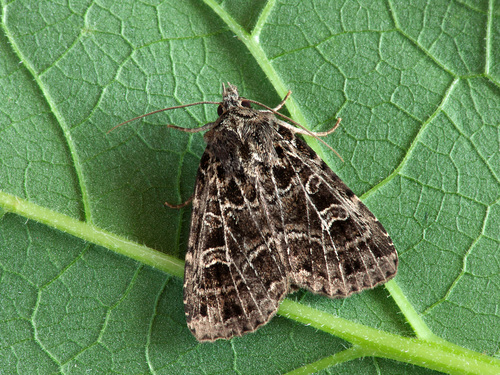
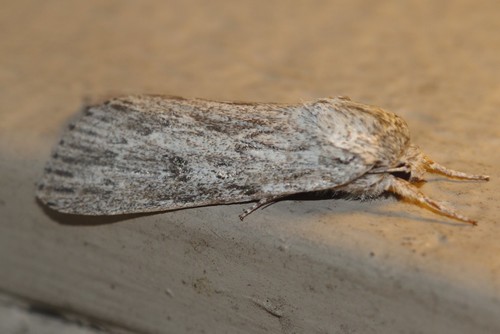
Adults of the smeared dagger moth (Acronicta oblinita J.E.Smith, 1797) have a wingspan ranging from 3.6 to 5.4 centimetres (1.4 to 2.1 inches). Their forewings have a mottled gray coloration. On the dorsal surface of each forewing, the orbicular and reniform spots are incompletely outlined and indistinct. Dark wedge-shaped spots with a smeared appearance sit along the postmedial line, with their pointed apices facing inward. A terminal line of dark spots is also present on the forewings. The hindwings are white, and also bear small dark spots along their terminal line.
The larval caterpillar reaches a maximum length of 4 centimetres (1.6 inches). It has numerous tufts of irritating setae growing on wart-like protuberances along its thoracic and abdominal segments. Between the laterally positioned spiracles, it has bright yellow blotches shaped like carets, which are inverted V forms.
This species ranges across Canada, extending as far north as Lake Athabasca. In the United States, it occurs in the Pacific Northwest, and east of the Rocky Mountains south to Florida and Texas.
Its habitats include bogs and coastal marshes in the Pacific Northwest, and more generally wetlands, forests and meadows. Specimens have also been collected from boreal forests in Canada.
The smeared dagger moth produces one to two generations each year. On the coastal plain of North Carolina, adult moths can be spotted from early March through late March through late June, and again from mid-August to early October. Caterpillars may pupate inside folded leaves of their host plant, and the species overwinters in the pupal stage.