About Acronicta euphorbiae (Denis & Schiffermüller), 1775
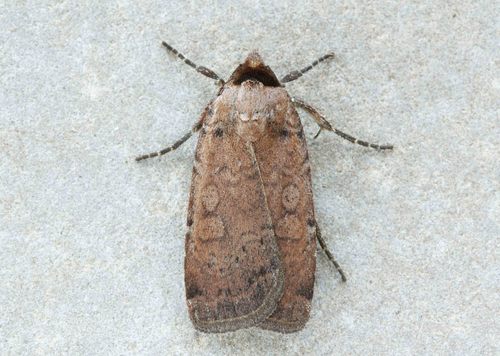
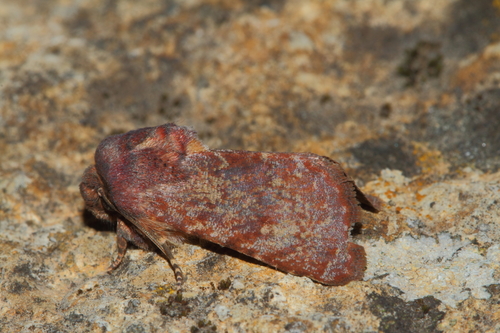
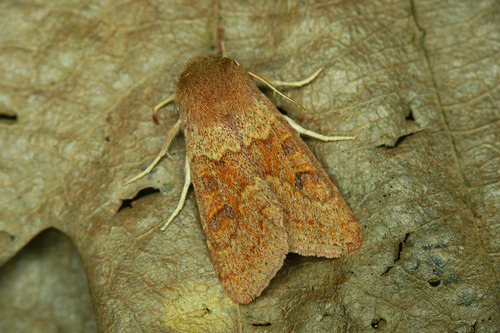
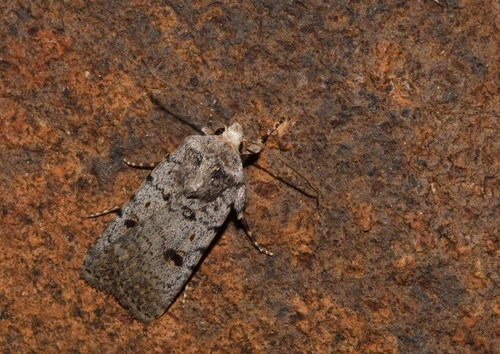
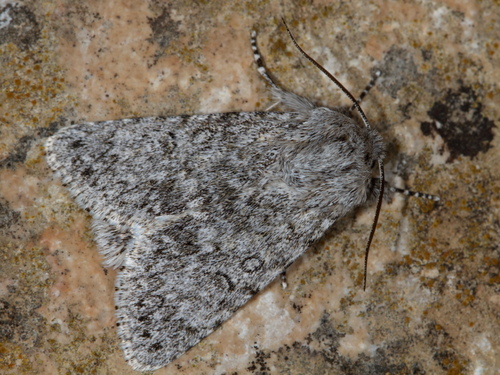
Acronicta euphorbiae (Denis & Schiffermüller), 1775, has a wingspan that reaches 32–40 mm. Females are slightly larger than males and have darker hindwings. Forewings are grey dusted with a darker shade; the orbicular stigma sits just beyond the inner line. Hindwings are white in males, and fuscous in females with pale cilia. Four named aberrations are recognized. The aberration montivaga Guen. is a mountain form with darker, bluer grey forewings, found in the Alps and Norway. The aberration myricae Guen., which occurs in the mountains of Scotland and Ireland, is even darker, with narrower, more pointed forewings, and is not smaller as Staudinger claimed. The aberration euphrasiae Brahm, which appears to be the most common form in France and south-western Europe, is paler than the type form and more luteous. Finally, the aberration esulae Hbn. is a distinctly small form with obscured markings. Unlike the adults, caterpillars of this species are brightly coloured, with hairy spikes, and become more colourful as they grow. This species is distributed through parts of the Palearctic south of a line running across southern Poland, starting from northern Scotland, through the border of northeastern Netherlands and northwestern Germany, extending southeastward through northern Czech Republic, Ukraine, and southern Russia to the Ural mountains. These moths prefer warm, sunny slopes, grassy heaths, moorland, and forests. In the Alps, they can be found at elevations over 2500 metres above sea level.