About Acromyrmex coronatus (Fabricius, 1804)
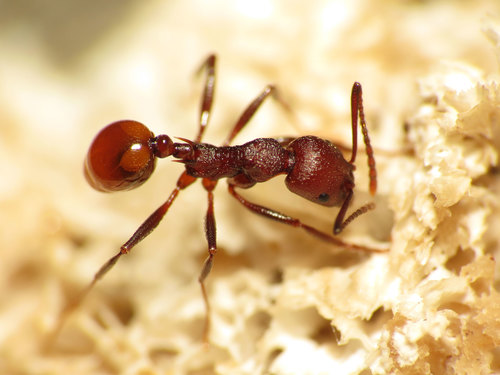
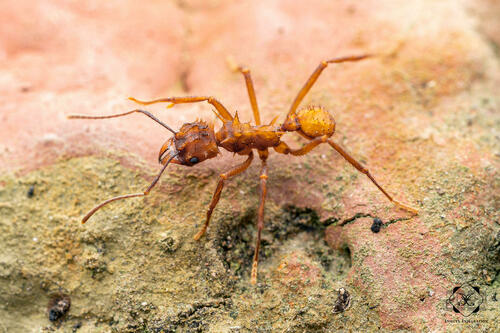
Acromyrmex coronatus is a New World ant belonging to the subfamily Myrmicinae. In the wild, its natural distribution ranges from Guatemala to Brazil and Ecuador. This is a montane species that tolerates cold, wet conditions, and its colonies are typically found in small clearings and gaps within dense cloud forest. Documented localities and elevation ranges include 1100 m on the north side of Volcan Barva (it is not found at 500 m or 2000 m at this site), 1600 m at Zurqui on the Central Valley side, and 800 m to 1700 m across the Monteverde area, from the Penas Blancas Valley up to the highest ridges, including within the Monteverde community area. In Monteverde, this ant is the main pest of gardens, and it enters houses at night to cut exposed bread, cabbage, or fruit. Nests of Acromyrmem coronatus are most often located in or under pieces of dead wood, and they usually have a superstructure made of loose, dead leaf fragments. The species does not excavate soil extensively, if it excavates soil at all. It may sometimes be arboreal, nesting in the low branch junctions of trees that host many epiphytes. Foraging activity of this species is continuous at night. Diurnal foraging only happens after recent rain: heavy rain triggers the start of diurnal foraging, which then gradually stops over one to two days. Periodic rains during the dry season trigger short periods of diurnal foraging, while more continuous rain leads to continuous diurnal foraging. This means the absence of diurnal foraging in the dry season is a short-term response to immediate environmental conditions, rather than a long-term change in colony foraging behavior. Nuptial flights are common in Monteverde, and distinctively patterned dealate queens are frequently seen on roads. Dealate queens have been observed cutting leaves, which suggests these queens need to forage on their own to successfully establish a new colony. Acromyrmex coronatus can be identified by several characteristics: median pronotal spines are usually present and distinct, though they are occasionally reduced or absent; the head tapers behind the eyes; and the head width is less than or equal to 1.7 mm.