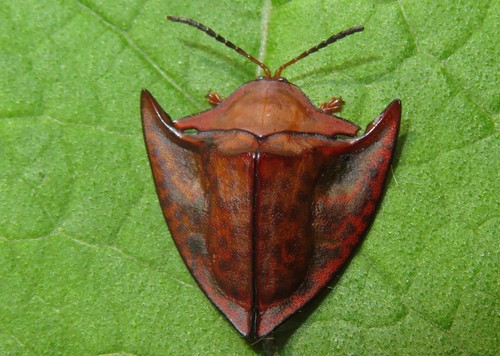
About Acromis spinifex (Linnaeus, 1763)
Like all other species in the genus Acromis, Acromis spinifex displays clear conspicuous sexual dimorphism. In males of this species, the elytra extend sideways and forwards to form flattened plates. Other better-studied species in the genus Acromis have been observed engaging in male-to-male combat, during which the flattened elytra regions are often pierced. Such piercing holes are commonly found in museum-held Acromis specimens. For adult A. spinifex, males measure 10.9–12.7 millimetres (0.43–0.50 in) long and 8.7–10.8 mm (0.34–0.43 in) wide. Females are slightly smaller, measuring 9.7–11.4 mm (0.38–0.45 in) long and 8.3–11.6 mm (0.33–0.46 in) wide. Acromis spinifex is distributed across South America, ranging from Trinidad and Tobago and Venezuela in the north to Peru, northern Argentina and Paraguay in the south. The host plants of A. spinifex belong to the family Convolvulaceae, most commonly Ipomoea species, including the sweet potato Ipomoea batatas. Known predators of this species are two shield bug species: Stiretrus smaragdatus and Stiretrus decastigma. Unlike most other tortoise beetles, Acromis spinifex provides parental care for its offspring. The female guards all developmental stages of the young beetles, from egg through to the pupa stage. The female lays a clutch of 15 white, oblong eggs. The eggs are glued together and attached to the midrib of a host plant leaf. Each individual egg measures 1.4–1.6 mm (0.055–0.063 in) long by 0.7–0.8 mm (0.028–0.031 in) wide. The final larval instar is 4.8–6.6 mm (0.19–0.26 in) long, with a yellowish body, brown head, and brown legs. Earlier reports of paternal care in this species came from a 1939 published illustration that incorrectly depicted a male guarding eggs.