About Acrocomia aculeata (Jacq.) Lodd. ex R.Keith
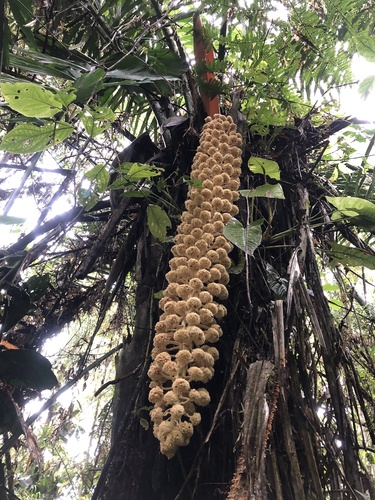
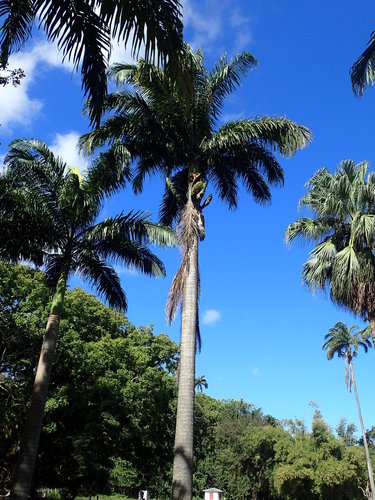
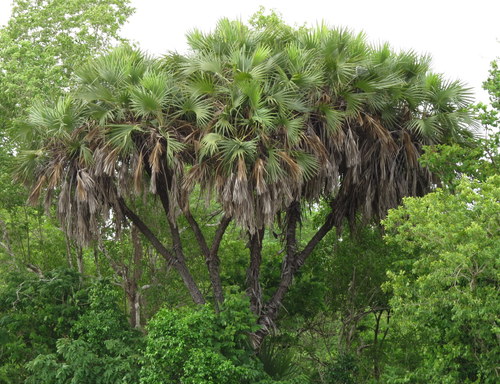
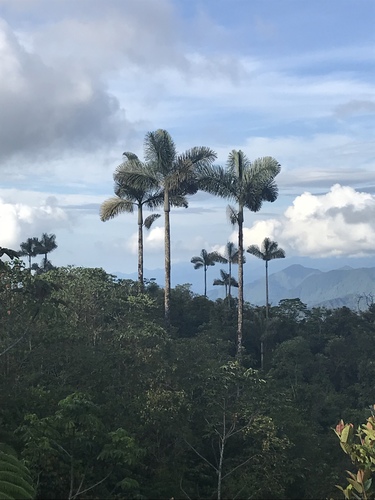
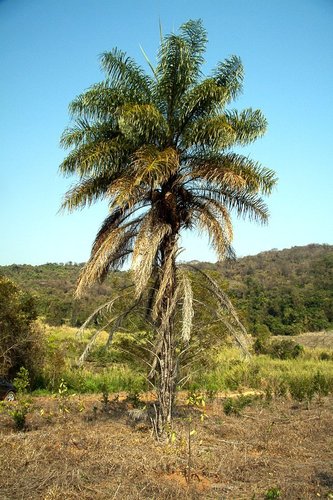
Acrocomia aculeata is a palm tree that generally reaches 10–15 m in height, and can grow as tall as 15–20 m (50–70 ft). Its trunk can reach up to 50 cm (20 in) in diameter, and is covered in numerous slender, black, sharply pointed 10 cm (4 in) long spines. Leaf petioles are also covered with spines. The leaves are pinnate, 3–4 m (10–13 ft) long, and hold many slender leaflets that measure 50–100 cm (1 ft 8 in – 3 ft 3 in) long. Small flowers grow on a large branched inflorescence that is 1.5 m (5 ft) long. The species produces a yellowish-green drupe fruit 2.5–5 cm (1–2 in) in diameter that turns yellow when fully ripe. The fruit has a hard outer shell and a slightly sweet, slimy, sticky pulp. The inner fruit shell, called the endocarp, is very tough to break, and usually holds a single dark brown, nut-like seed 1–2 cm (1⁄2–3⁄4 in) in diameter. The interior of the seed, called the endosperm, is a dry white filling that has a vaguely sweet, coconut-like taste when eaten. This species is distributed from southern Mexico and the Caribbean south to Brazil, extending into Paraguay and northern Argentina. It grows in a wide range of environments, including Cerrado savanna, Mata Atlântica rainforest, grasslands, and subtropical forests. In 1863, English naturalist Henry Walter Bates noted in his book The Naturalist on the River Amazons that hyacinth macaws feed especially on the hard nuts of this palm (referred to by Bates as Acrocomia lasiospatha, locally called Mucuja). Bates observed that even though these nuts are hard enough to be difficult to break with a heavy hammer, the macaw can crush them into pulp with its powerful beak. Optimal cultivation practices to support healthy growth and productivity of Acrocomia aculeata have a few key requirements. This palm grows best in soils rich in organic matter and nutrients, so fertilization supports optimal plant health and productivity. Research recommends applying approximately 100–150 kg of nitrogen per hectare annually, split throughout the growing season to match the plant’s needs and prevent nutrient loss. Macauba palms require well-distributed rainfall, but can tolerate drought if they receive supplemental irrigation when needed. A planting density of 150-200 palms per hectare is recommended for optimal growth, to give each plant enough space to grow and bear fruit effectively. Macauba oil and its by-products are used in biodiesel production, cosmetics, food, and other bio-based products, and contribute to sustainable agriculture and rural economies. Although the species has traditionally been used more often for non-edible purposes, so it has been less common in the food industry, macauba oil has a fatty acid composition similar to olive oil, which suggests it may have potential applications as a food-grade vegetable oil. The pulp oil is rich in monounsaturated fats, primarily oleic acid, which supports heart health and reduces LDL cholesterol levels. Studies indicate that macauba oil could be a valuable cooking oil or ingredient in food processing, as long as it meets required food safety standards. The trunk of this palm can also be “milked” to produce a fermented alcoholic beverage called coyol wine.