About Acrocinus longimanus (Linnaeus, 1758)
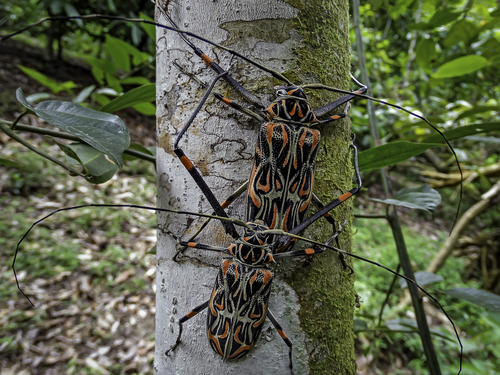
The harlequin beetle, scientifically Acrocinus longimanus, is a large, distinctly colored longhorn beetle species native to the Neotropics. It is the only member of the genus Acrocinus. It gets its common English name from the elaborate pattern of black, orange-red, and greenish-yellow markings present on both sexes. Even with this bright patterning, the beetle is well-camouflaged when it perches on a tree trunk covered in lichen or fungus. The species epithet longimanus is Latin, referring to the extremely long forelegs of large males; these forelegs are longer than the beetle’s entire body. The head-and-body length of this beetle ranges from 4.3 to 7.5 cm (1.7–3.0 in). Its large size and unusual appearance have made the harlequin beetle popular with insect collectors. While it is essentially harmless to humans, it may bite in self-defense using its strong mandibles. The harlequin beetle inhabits tropical and subtropical regions of the Americas. Its range extends from Mexico, through Central America and South America, reaching as far south as the northernmost part of Argentina (Corrientes and Misiones), the southernmost part of Brazil (Rio Grande do Sul), and Paraguay. It also lives on the Caribbean island nation of Trinidad and Tobago, but a recorded occurrence on Barbados is considered incorrect. It has been recorded in every Central American country and every South American country, with the exceptions of Chile and Uruguay. In Mexico, its full distribution is not completely known, but it occurs in southern Mexico, ranging north along the western side of the central plateau to Sinaloa, and along the eastern side to San Luis Potosí. The harlequin beetle is locally common. Most records are from undisturbed forests, but it also lives in secondary forest, and occasionally even appears in cities if green areas are nearby. Most of its South American range falls within the Amazon and Atlantic forests, but it also occurs locally in the Cerrado and Caatinga. In northwestern South America, it is found in both humid and fairly dry lowland and highland forests on both sides of the Andes, in interandean valleys, and in the coastal Caribbean region. It has been recorded at elevations up to 2,150 m (7,050 ft) above sea level.