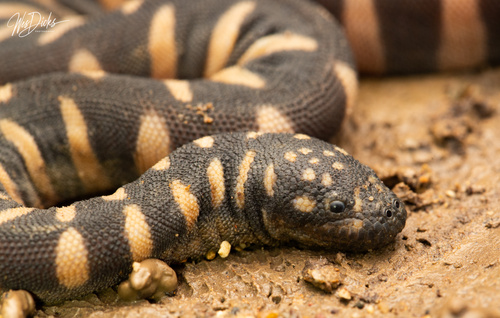
About Acrochordus granulatus (Schneider, 1799)
Common Names & Taxonomic Status
Acrochordus granulatus is the smallest of the three species in the family Acrochordidae, and is commonly known as the "little file snake". It is also the only member of the genus Acrochord that permanently lives in estuaries and coastal seas, which gives it another common name: the "marine file snake".
Terrestrial Mobility Adaptation
All other Acrochordus species are fully aquatic and nearly helpless on land, but A. granulatus is an exception. This species has hygroscopic skin that slows drying out, which lets it travel out of water.
Scale & Sensory Tubercle Structure
Like other species in its genus, A. granulatus has uniquely spinose scales with an almost rough texture. All Acrochordus also have specialized tubercles with nerve endings on the skin between their scales. These tubercles act as an extra sensory organ that detects water movements from prey.
Locomotion Adaptations
A. granulatus has laterally compressed tails, and can flatten its body dorsoventrally to help it swim.
Salt Gland Adaptation
This species is the most marine-adapted of all Acrochordidae, and has specialized sublingual salt glands similar to those found in the true sea snake subfamily Hydrophiinae.
Freshwater Intake Behavior
Even with these glands, A. granulatus is still at risk of dehydration at sea, and relies on freshwater lenses that form on the surface of marine water to get fresh water. Members of the true sea snake subfamily Hydrophiinae have been observed showing this same behavior.
Sexual Dimorphism
A. granulatus is sexually dimorphic, with females growing slightly larger than males.
Geographic Range Overview
This snake's geographic range extends from both coasts of peninsular India through Southeast Asia, the Indo-Australian Archipelago and northern Australia to the Solomon Islands.
Confirmed Distribution Locations
Confirmed locations within this range include Bangladesh, Myanmar, Sri Lanka, the Andaman and Nicobar Islands, Thailand, Cambodia, Vietnam, China (Hainan), the Philippines (Luzon, Cebu and Batayan), Malaysia, Indonesia (Sumatra, Java, Borneo, Flores, Timor, Sulawesi, Ternate, Ambon, and coastal Irian Jaya), Papua New Guinea, the Solomon Islands, and the northern Australian coast (Northern Territory and eastern Queensland).
Type Locality Notes
No type locality was included in the original species description, though Smith (1943) lists the type locality as "India", and Saint-Girons (1972) lists it as "Inde."


