About Acrobates pygmaeus (Shaw, 1793)
Common Name and Size
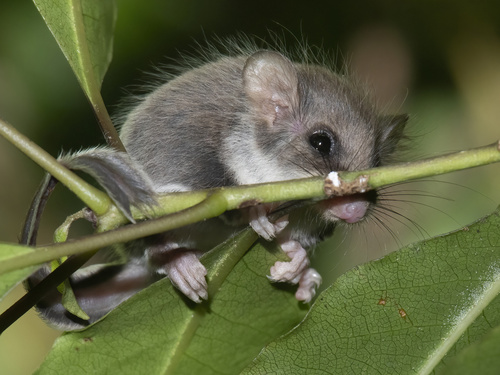
Acrobates pygmaeus, commonly called the feathertail glider, is the world’s smallest gliding mammal, reaching only 6.5–8 cm in head-and-body length and weighing approximately 12 g, around the size of a small mouse.
Body Fur Coloration
Its fur is soft and silky, with a uniform greyish brown color on its upper body and white coloring on its underside.
Facial Features
It has dark fur rings around its eyes, a hairless, deeply cleft rhinarium, and moderately large, rounded ears.
Whisker Distribution
The species also has an unusually large number of whiskers that grow from the snout, cheeks, and the base of each ear.
Patagium Structure
Like other gliding mammals, the feathertail glider has a gliding membrane called a patagium that stretches between its fore and hind legs.
This patagium only reaches the elbows and knees, making it smaller than the patagium of petaurid gliding possums, though a fringe of long hairs increases its effective gliding area.
Tail Morphology
Its tail is roughly the same length as its combined head and body, oval in cross-section, and only slightly prehensile.
Most of the tail has very short fur, with the exception of two distinct rows of long, stiff hairs along each side that give the tail the appearance of a feather or double-sided comb.
Hindfoot Structure
The hindfeet have enlarged, opposable first digits that do not have claws, unlike all other toes on both the front and hind feet.
Tongue Structure
The feathertail glider has a long, thin tongue that can reach up to 11 mm in length, covered in numerous long papillae that give the tongue a brush-like shape.
Tongue Function
This structure improves the glider’s ability to collect pollen and eat semi-liquid food.
Ear Bony Structure
Its ear structure is also unusual: the species has a unique bony disc with a narrow crescent-shaped slit positioned just in front of the eardrum.
Ear Structure Function Hypothesis
The function of this bony structure is unclear, though it may act as a Helmholtz resonator to increase sensitivity to specific sound frequencies.
Brain Weight
Recorded brain weight for the species is 360 milligrams.
Female Reproductive Tract
Females have two vaginae that merge into a single sinus before opening into a cloaca alongside the rectum.
Female Pouch Characteristics
As is typical for diprotodont marsupials, the female’s pouch opens toward the front, and it holds four teats.
Geographic Distribution
Feathertail gliders are found along the entire eastern seaboard of continental Australia, ranging from northern Queensland to Victoria, and into extreme south-eastern South Australia.
Subspecies Status
No subspecies of the feathertail glider are currently recognized.
Habitat and Elevation Range
The species lives in a wide variety of forest types across its range, from sea level up to at least 1,200 m.
Fossil Record
Fossils from the genus Acrobates, dated to the late Pleistocene around 0.5 million years ago, have been found in deposits in Queensland.


