About Acridocarpus natalitius A.Juss.
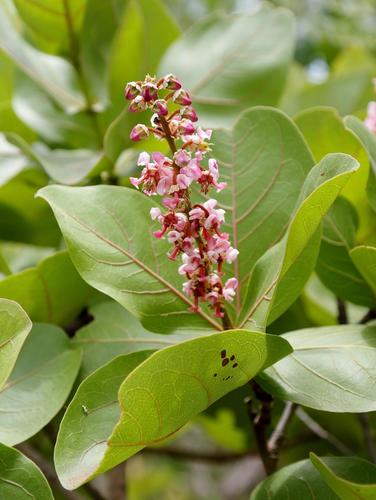
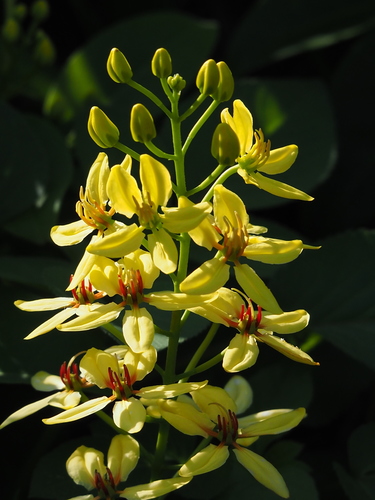
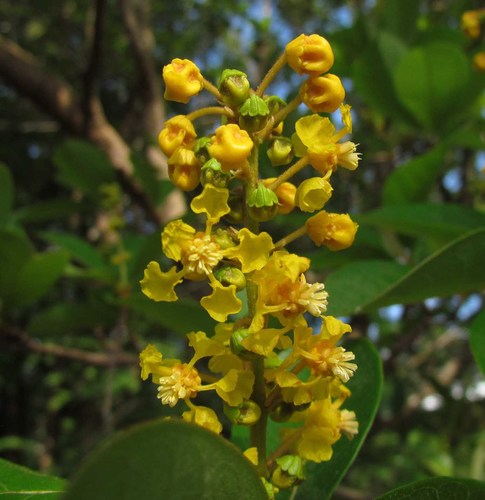
Acridocarpus natalitius A.Juss. is an evergreen plant with a highly variable growth form, ranging from a twining vine that grows on other plants to a small tree reaching 1–5 m (3.3–16.4 ft) in height. Its bark is grey and rough. Young stems and leaves may be covered in pinkish hairs, which are shed as the plant parts age. Once the hairs are lost, the alternately arranged, leathery leaves become shiny green; they have a distinct midrib with net-like veins. Dark glands may occur where the petiole connects to the leaf blade, or on the underside of the leaf blade. Yellow flowers grow on this species between September and February, and the spreading petals have lacerated edges. Fruits develop between November and April, and each bears two or three elongated triangular wings. The way the wings are fused gives the fruit the appearance of a moth with spread wings, which gives the plant its common name. This is the southernmost species of its genus. It grows in subtropical dry forests, shrubland, coastal forests, sand forests, and savannas. Its distribution ranges from Pondoland to Limpopo in South Africa, and extends eastwards to Eswatini and Mozambique. The flowers are visited by ants and bees. This species produces samara fruits in summer, each with two to three veined wings that resemble a moth with open wings. It acts as a host plant for skipper butterflies, and its leaves are eaten by game. This plant is still frequently sold in South African Muthi markets, which are markets for traditional medicines. If consumed, the powdered root of this plant causes vomiting and diarrhoea. It is also used to make ointments. It has several non-medical traditional uses as well. Along with other ingredients, the roots are used to make a mixture called intelezi, which is claimed to hinder court procedures by making the accuser mute, repetitive, or irrelevant. Intelezi may also be sprinkled around a homestead during a thunderstorm, used to strengthen fighting sticks, or used to induce vomiting to cleanse an entire family. Herdboys may place a piece of the root under their tongues to avoid punishment if their cattle wander into crops, and the roots can be used to avert anger after someone commits a fault.