About Acraea terpsicore (Linnaeus, 1758)
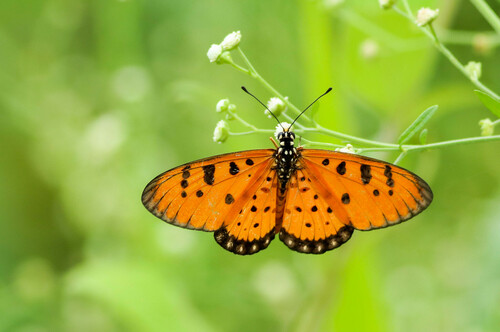
Acraea terpsicore (Linnaeus, 1758), commonly called the tawny coster, is a small leathery-winged butterfly. It measures 53 to 64 millimetres (2.1 to 2.5 inches) across, belongs to the brush-footed butterfly family Nymphalidae, and is common in grassland and scrub habitats. This species has a weak, fluttery flight and is avoided by most insect predators. Along with the yellow coster (Acraea issoria), it is one of only two Indian representatives of the mostly African tribe Acraeini. Its known range spans from India, Sri Lanka, and the Maldives to Myanmar, Thailand, Laos, Cambodia, Vietnam, Bangladesh, Malaysia, Singapore, Indonesia, and it has recently been recorded in Australia. This butterfly does not fly high, typically staying within 3 meters of the ground, and usually rests on vegetation around 1 meter above ground. It can be found in large numbers wherever its larval food plant (Passiflora species) grows. Adults avoid dense undergrowth and shady areas, and prefer open spaces in all types of vegetation. Adults fly slowly, with weak, seemingly unsteady wing beats. It is one of the boldest butterfly species, because it is protected from predators by a nauseous chemical. When attacked, it plays dead and exudes a noxious yellowish fluid from glands in the leg joints. Like all butterflies protected this way, Acraea terpsicore has a tough exoskeleton that allows adults to survive a few pecks from a bird or even bites from a lizard. Once it is left alone, the adult immediately takes flight again and resumes its unhurried flight. When feeding on flowers, this butterfly moves slowly, often spending a long time resting on the same flower. When sitting, it either spreads its wings or closes them over its back, with the hindwings covering most of the forewings. Sometimes it does not fully sit, and instead rests gently on the flower while feeding; to maintain balance in this position, it beats only its forewings while keeping the hindwings completely still. For its life cycle, this butterfly breeds on plants from the family Loganiaceae and Passiflora species, many of which contain toxins that are sequestered by the caterpillars. Caterpillars have also been recorded feeding on the leaves of Hybanthus enneaspermus (Violaceae) in Bengal, and on Turnera ulmifolia (Passifloraceae) in Maharashtra.