About Acraea esebria Hewitson, 1861
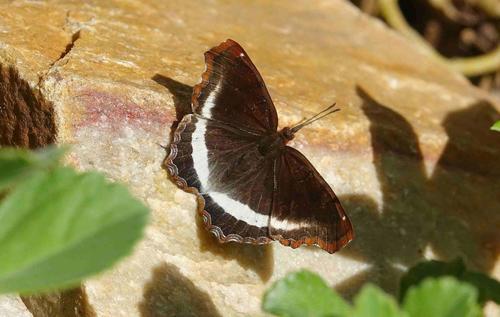
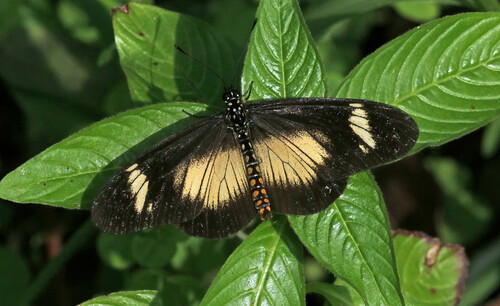
Acraea esebria, commonly called the dusky acraea, was first described by Hewitson in 1861. Its wingspan measures 45–55 mm for males and 53–60 mm for females, and both sexes share the same full range of possible colouration. This is a highly variable species; the most common morph is black, with a white band crossing the forewing, plus a white patch on the lower forewing and another on the hindwing. Multiple morphs with different coloured light markings have been formally described, including morphs with white, yellow, or orange patches: f. ertli, f. esebria, f. protea which is black with creamy-yellow patches, f. monteironis which is black with white patches, and f. jacksoni. In Seitz's description, the numerous forms of A. esebria differ primarily in the colour of their light markings, the breadth of the forewing's subapical band and hindmarginal spot, and how developed the dark marginal band is on the upperside of the hindwing. According to Trimen, the larva is light ochre-brown, with a black transverse streak edged with light yellow across the middle of each segment. It has a black head, and black spines, with only the lateral spines on segments 5 to 11 being yellow. The larvae feed on plant species belonging to the genus Fleurya. The pupa is white with a slight yellowish tint, marked with fine black lines and small black spots. The first three abdominal segments bear orange-yellow dorsal spots bordered with black, with a small small raised structure in the center of each spot; the points on the head are short. For the nominate form esebria Hew., the forewing's hindmarginal spot is large and broad, almost reaching the base of cellules 1a and 1b, covering the base of cellule 2, and is brown-yellow. The subapical band is narrow, and its spots in cellules 5 and 6 are shorter or at most not longer than the black basal part of these cellules; it is light ochre-yellow or whitish yellow in males, and white in females. The upperside of the hindwing is brown-yellow with a black marginal band around 4 mm broad. This form ranges from the Cape region to the Congo and British East Africa. The morph jacksoni E. Sharpe (57 d) is very similar to the type-form, differing only in that the forewing's subapical band is the same dark colour as the hindmarginal spot and is broader. In females, the subapical band is even broader and reaches vein 2, where it touches the hindmarginal spot. The breadth of the hindwing's marginal band is very variable in this morph. It is found from Mashonaland to British East Africa. The aberration ab. ertli Auriv. is very closely related to jacksoni, differing primarily in that the forewing's subapical band is even broader and white. The forewing's hindmarginal spot and the upper surface ground colour of the hindwing are red-yellow in females, and light ochre-yellow in males. It occurs in Usambara. The form f. pseudoprotea Btlr. closely resembles the type-form, differing only in that the ground colour of the upperside of the hindwing and the forewing's hindmarginal spot are lighter yellowish, and the hindwing's marginal band is narrower. This form is found in Angola. The female aberration female-ab. amphiprotea Btlr. is also similar to the type-form, with only two notable differences: the dark marginal band on the upperside of the hindwing is not sharply defined along its proximal edge, and the forewing's subapical band is light brown-yellow, matching the colour of the other markings. It is found in Angola. The female form female-f. metaprotea Btlr. has the very broad subapical band and large hindmarginal spot of the forewing touching in cellule 2, and both are light brown-yellow. The hindwing is an even lighter brown-yellow, and only has a dark marginal line rather than a full dark band. This form is similar to jacksoni and occurs in Angola. The female aberration female-ab. nubilata Eltr. has darker areas that are sepia black. The base of the forewing cell, the inner-marginal patch, and the basal half of the hindwing are dark sepia grey. The forewing's subapical band is greyish white. It occurs in Zululand. The next three forms differ from all the preceding forms in having a smaller, narrower hindmarginal spot on the forewing, which always leaves the base of cellules 1a and 1b uncovered, and barely if at all covers the base of cellule 2. masaris Oberth. (57 c), which is now classified as the separate species Acraea masaris, is on average smaller than A. esebria. Its light markings are red-yellow or brown-yellow in males, and white or light yellow in females. The subapical band is scarcely broader than in the A. esebria type-form. It is found in the Comoro Islands, with very similar forms also occurring in Usambara. protea Trim. (57 c) can be immediately recognized by its small, not sharply defined forewing hindmarginal spot, which does not extend beyond vein 2. The forewing's subapical band is narrow, and its spots in cellules 4-6 are never longer than the black basal part of the cellules. The base of the upperside of the hindwing is blackish, often extending out as far as vein 2, and the hindwing's marginal band is broad. Its light markings are light yellow in males, and light yellow or white in females. This form ranges from the Cape region to Angola and British East Africa. f. monteironis Btlr. (57 d) is similar to protea, and like protea it has a small hindmarginal spot on the forewing, bounded anteriorly by vein 2. All of its light markings are white, and rarely light yellow. It differs from protea in having a long, broad forewing subapical band that is about 6 mm in breadth and usually also has a spot in cellule 2. This form is found in Angola, Mashonaland, German East Africa, and British East Africa. This species is distributed from the Eastern Cape of South Africa to Zimbabwe, and also occurs in Mozambique, Malawi, Zambia, southern Democratic Republic of the Congo (Shaba), Angola, Tanzania, and eastern Kenya east of the Rift Valley.