About Acontia trabealis (Scopoli, 1763)
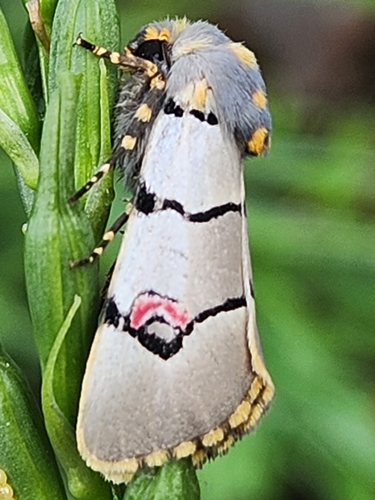
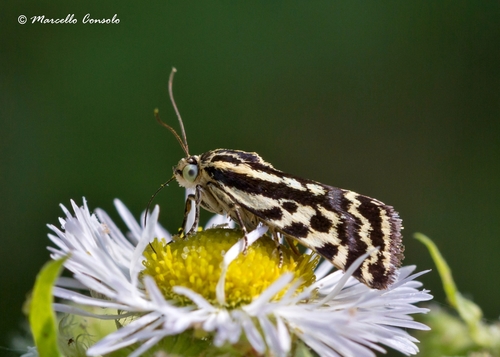
This species has the accepted scientific name Acontia trabealis (Scopoli, 1763), and is also referenced under the synonym Emmelia trabealis. The wingspan of adults can reach 18–24 mm. The forewings have a yellowish or dirty white base color with highly variable black markings, and hindwings are reddish brown. Eggs are green, elongated and cone-shaped, with a flattened base and distinct longitudinal ribs. Caterpillars range in color from reddish to greenish brown, with dark dorsal lines and a yellow side band; the head is relatively small and brown. Cocoons are red brown or green. This technical description covers known variation: Forewings are pale yellow with black markings that, when fresh, are edged with lustrous scales. Horizontal black streaks run from the base along the median and submedian veins. The wing lines are marked by black costal spots, with the outer and subterminal lines more or less complete, and sometimes interrupted. Two black spots represent the stigmata. The yellow fringe is marked with black in the middle and at each end. The hindwing is reddish fuscous, with a yellowish white fringe. This species varies based on whether yellow or black scaling is more dominant; as a rule, yellow is more prominent in females, while black is more prominent in males. The aberration nigra Ersch., found in West Turkestan, is almost entirely black. Mature larvae that have changed color from green to brownish have darker dorsal and subdorsal lines with faintly paler edges, and a broadly pale yellow spiracular line. Commonly called the spotted sulphur, this moth is found across most of the Palearctic realm, including Europe, North Africa, the Middle East, and the region from Russia to northern China and Japan. It was formerly resident in Great Britain, but has not been observed at any known breeding colonies since 25 June 1960, and is presumed extinct there. This species prefers dry, warm areas with sandy soil, meadows, and sunny slopes where bindweed grows.