About Acoelorraphe wrightii (Griseb. & H.Wendl.) H.Wendl. ex Becc.
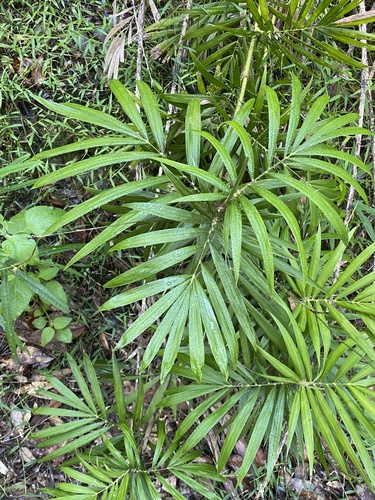
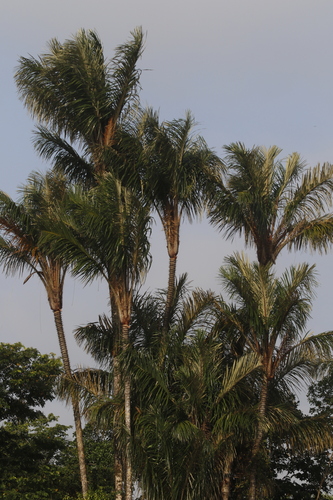
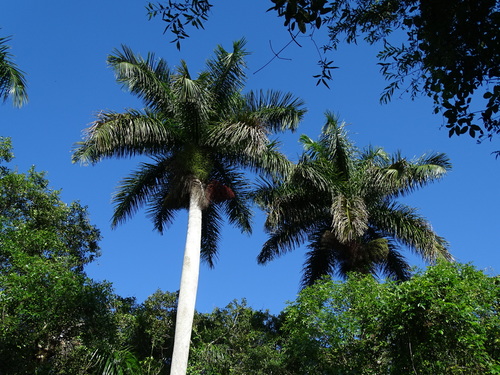
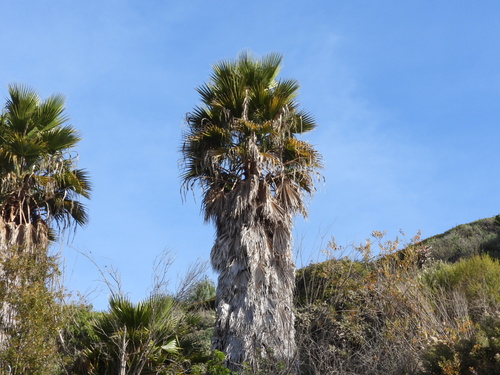
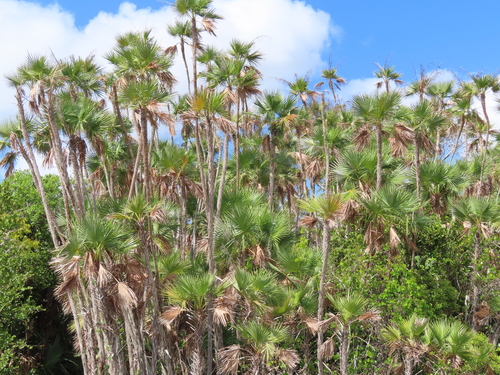
Acoelorraphe wrightii is a small to moderately tall clustering palm. It usually reaches 5–7 metres (16–23 ft) in height, and rarely grows as tall as 9 m (30 ft). Its stems are slender, with a diameter of less than 15 centimetres (5.9 in), and the trunk is covered in fibrous matting. This species has fan-shaped (palmate) leaves, where leaf segments are joined to each other for approximately half their length. The leaves are 1–2 m (3.3–6.6 ft) wide, light green on the upper surface, and silver on the underside. The leaf petiole is 1–1.2 m (3.3–3.9 ft) long, and bears orange, curved, sharp teeth along its edges. Its flowers are minute, inconspicuous, greenish, and have 6 stamens. The fruit is pea-sized; it starts orange and turns black when fully mature. This palm is native to Central America, southeastern Mexico, the Caribbean, Colombia, the Bahamas, and extreme southern Florida. It grows near sea level, in thin rocky soil over limestone, in wet areas and the swamps of the Everglades. Paurotis palm was formerly abundant in the Florida Everglades, but large numbers of wild plants were harvested for the nursery trade. Wild populations of this palm are now protected under Florida law, and their numbers are increasing again. Nurseries currently offer cultivated plants propagated from seed, or by sawing apart the base of existing clusters. This palm is hardy in central and southern Florida, and is grown as a landscape palm.