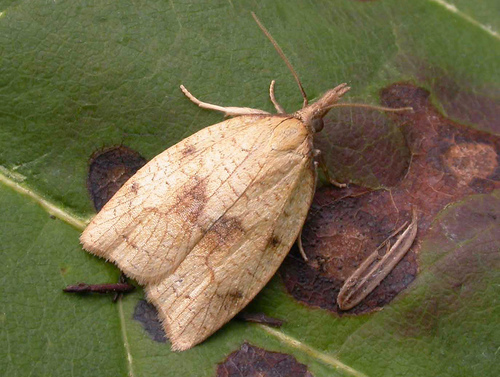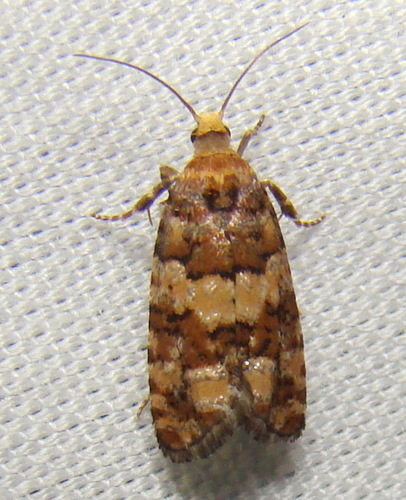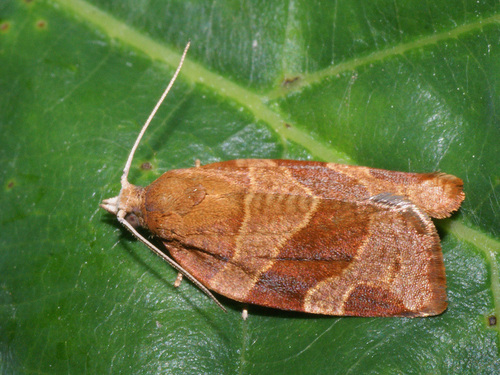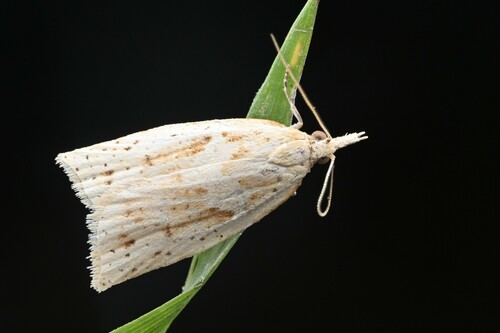
About Acleris semipurpurana (Kearfott, 1905)
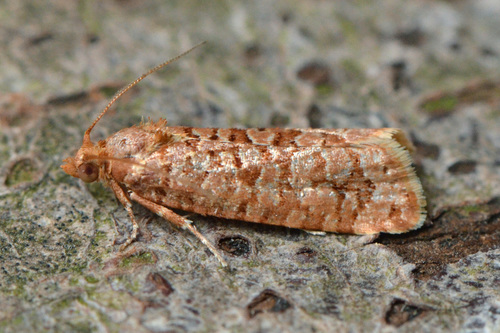
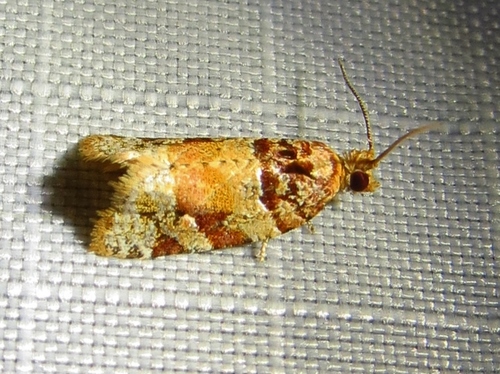
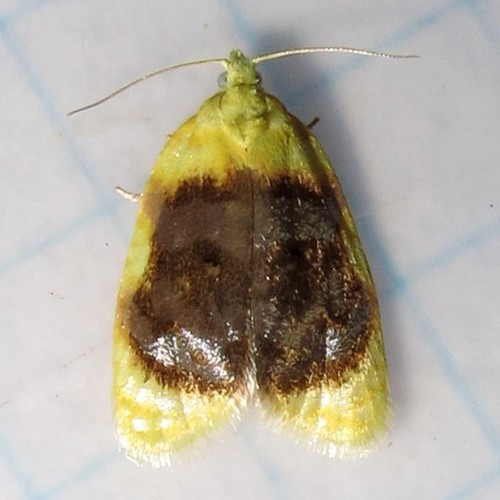
Acleris semipurpurana, commonly called the oak leaftier moth, was first described by William D. Kearfott in 1905. Adult oak leaftier moths lay their eggs annually in June, usually as single eggs on rough-bark twigs, specifically second year branches. The eggs overwinter and hatch the following spring. When larvae (caterpillars) emerge in April, they feed on oak tree buds and the young leaves inside those buds. Fully grown larvae reach 12 millimetres (0.47 in) in length, and have a dirty white to light green body, a pale brown head, and black to brown front legs. Additional identifying traits of the larvae include a long head with a black bar on the cheek or lower portion, and brown thorax legs. Larvae tie leaves together with silk, which gives this insect its common name. They feed and nest inside these tied or folded leaves until mid- to late May, when they prepare to pupate. The larvae leave the trees by descending to the ground on silken threads to pupate, and pupae are commonly found in leaf litter on the forest floor beneath oak trees. After one or two weeks in the pupal stage, adult moths emerge in late May or June. Adults are small moths with a wingspan of 12 millimetres (0.47 in), and their wings hold a characteristic bell shape. Wing color varies considerably: some forewings are yellow, while others have dark brown or even purple markings. After emerging, adults mate and lay eggs, and only one generation is produced each year. This species is found in the eastern United States and adjacent parts of southeastern Canada. In the United States, its range extends from New York, Massachusetts, Connecticut, and Pennsylvania in the northeast to Minnesota and Texas in the west, and it is also present in the Canadian province of Ontario. Oak leaftier larvae feed mainly on oak trees (genus Quercus) in the red oak section Lobatae, specifically eastern black oak, northern red oak, pin oak, scarlet oak, and scrub oak. Multiple moth species share the common name oak leaftier; most belong to the family Tortricidae, with a small number from three other minor families. Among these species, Acleris semipurpurana is the most common and one of the most significant for causing oak defoliation. It often shares host trees with other pest species, including Archips semiferanus and other oak leafrollers. Young larvae destroy developing buds and leaves, or cause emerging leaves to develop with many holes. This can severely drain a tree's food reserves, and older larvae can eat nearly all remaining leaves, resulting in full defoliation. When a tree is defoliated two or more years in a row, this causes branch dieback, reduced diameter growth, and overall tree decline. The oak leaftier has caused considerable tree mortality, particularly in the Appalachian region. Dead wood in affected trees is subsequently attacked by fungi such as shoestring root fungus and wood borers like the twolined chestnut borer. A major outbreak of Acleris semipurpurana occurred during the 1960s and 1970s across Connecticut, Massachusetts, New York, Pennsylvania, Virginia, and West Virginia, with Tiadaghton State Forest in north central Pennsylvania hit especially hard. Natural pest control methods usually keep Acleris semipurpurana populations in check, but chemical pesticides are sometimes used when populations are high.