About Acleris rhombana (Denis & Schiffermüller), 1775
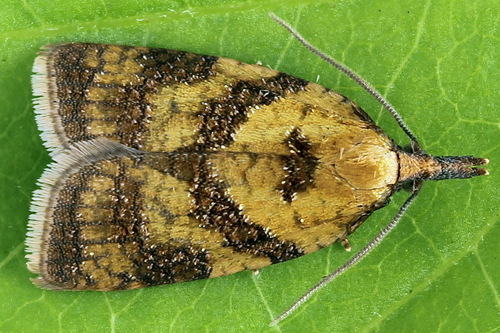
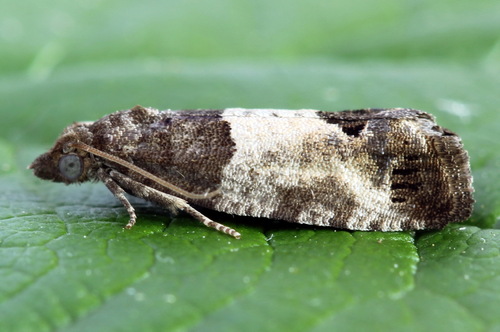
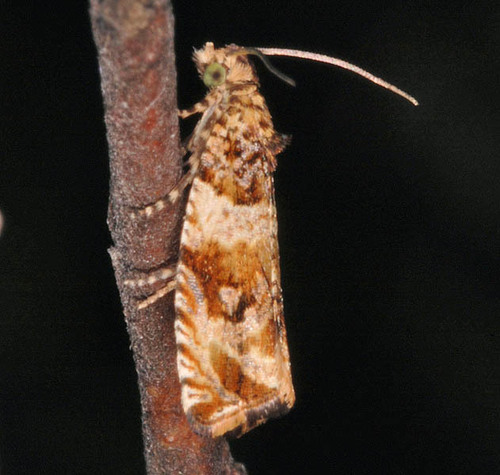
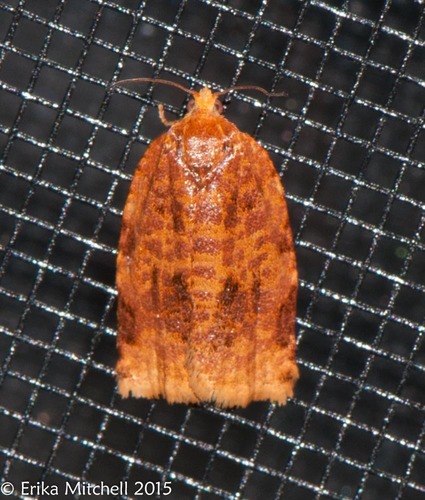
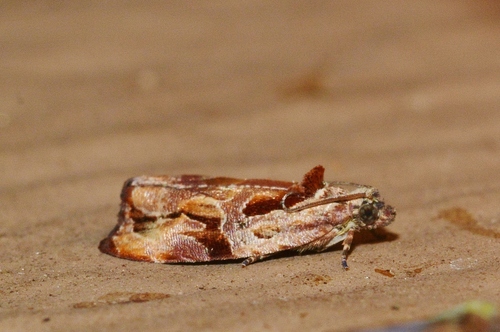
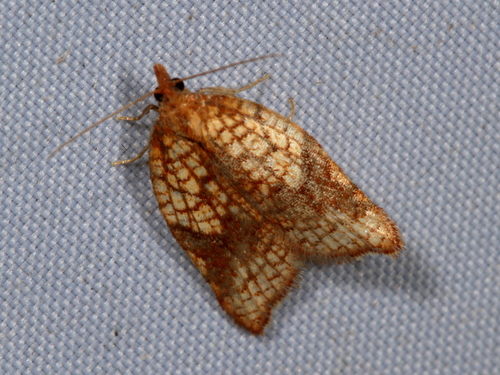
Acleris rhombana, commonly known as the rhomboid tortrix, is a moth species belonging to the family Tortricidae. Its scientific name is Acleris rhombana (Denis & Schiffermüller), 1775. This moth occurs in the Palearctic realm, with a distribution ranging from Europe east to the Caucasus, Armenia, and Turkmenistan. The wingspan of adult individuals measures 14 to 18 mm. The forewings are suboblong, with a rather strongly prominent apex. Their base color ranges from whitish-ochreous to reddish-ochreous, sometimes heavily mixed with fuscous, and they are strigulated with dark fuscous or ferruginous. The veins are dark fuscous, and the raised tufts on the wings are very slight. The edge of the basal patch is usually dark fuscous, and the angulated central fascia and costal patch are often rather dark fuscous; these markings sometimes unite in the disc of the wing. The apical half of the cilia is white on the upper portion of the termen. The hindwings are grey-whitish, with indistinct grey strigulation. Fully grown larvae are pale green-yellowish, with a pale brown head and a green anal plate. Julius von Kennel has published a full formal description of the species. Adult moths are on wing from June to November, with the flight period varying by location. Larvae feed on a variety of deciduous trees and shrubs, including species in the genera Crataegus, Malus, Pyrus, and Prunus, as well as other members of the plant family Rosaceae.