About Aciphylla subflabellata W.R.B.Oliv.
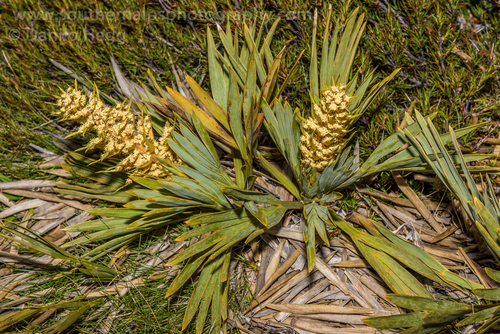
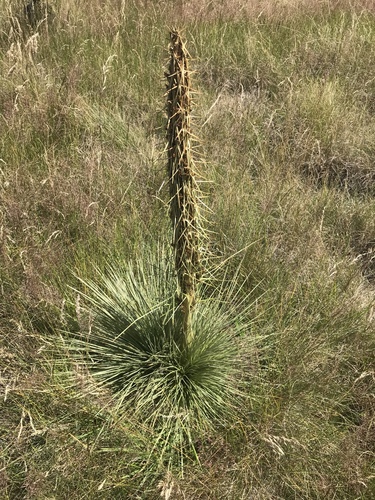
Aciphylla subflabellata W.R.B.Oliv. is one of the larger species in the genus Aciphylla, and produces clear exudate. It is a perennial herb that forms stout rosettes of spiky leaves that reach 50 to 80 cm. Its leaves are distinctively fan-like and flattened: the leaf pinnae are closely spaced and lie roughly in the same plane as the leaf axis. Classified as a spear grass, it produces stems that can grow to 80 cm tall, with a dense rosette at the top of each stem. The stems are subfellate to pinnate in shape and typically yellow-green. They grow up to 25 mm in diameter, with a 2 cm sheath that splits into 2 to 4 ligules, each of which holds leaflets that can reach 25 cm long and 3 mm thick. The full mature plant can reach 1 metre in total height.
The flowering stem grows up to 1 m tall and 25 mm wide, and bears an inflorescence 50 to 60 cm long. Its yellow flowers bloom from December to February, and wind-dispersed seeds are released from February to May. In the original species description, Oliver noted that A. subflabellata is most similar to A. squarrosa in its narrow leaves and downturned terminal bract segments, but its finely-toothed terminal bracts are much longer (up to 30 cm) and its leaves are always bipinnate. A. subflabellata also has more finely divided, flattened leaves than A. squarrosa, and is usually much smaller overall.
A. subflabellata is endemic to New Zealand, where it is only found on the eastern side of the South Island, ranging from south-eastern Marlborough to Southland, at altitudes between 300 and 1,400 metres (980 to 4,590 ft). It prefers dry subalpine sites, and sometimes grows among rocks. Small populations of this spear grass occur in Canterbury, including on Banks Peninsula. It has been grown from seed and planted on Banks Peninsula for ecological restoration.
This spear grass typically grows in dry climates among tussock grasses and rock, and is well adapted to alluvial terraces, basins, and rolling hills. It does not tolerate humid climates or consistently wet conditions.
In terms of life cycle and phenology, A. subflabellata flowers in the summer months of December to February. Its yellow flowers are pollinated by insects during a synchronized pollination period. This species is dioecious, meaning individual plants are either male or female. After pollination, fruit develops between February and May. When ripe and dry, the fruit splits apart to release seeds, which are then dispersed by wind. A. subflabellata is easy to cultivate and grows relatively quickly. Once planted, it is best not to transplant the plant or disturb its roots.
For cultural use, Māori use species in the genus Aciphylla to make perfume. Māori collected resin from two identifiable species, small and large taramea; generally only the larger taramea was used to make perfume. The collected resin could also be used as a medicinal remedy. Taramea is currently classified as a taonga under the 1998 Ngāi Tahu Treaty of Waitangi settlement.