About Aciphylla aurea W.R.B.Oliv.
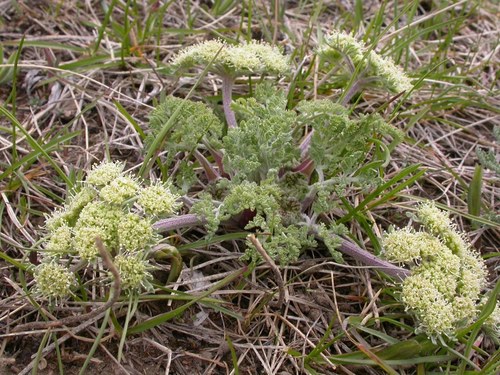
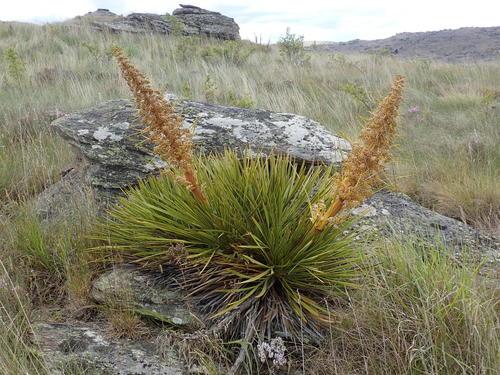
Aciphylla aurea W.R.B.Oliv. is a species of tufted herb. Plants are yellow-green, and reach up to 1.5 m in height when in flower or fruit. They form spiky rosettes up to 1 m across, and are dioecious, meaning individual plants are either male or female. Leaves grow up to 70 cm long, and are once- or twice-pinnately compound with petioles. They have thick, wide sheaths and stiff, sharp, tapering stipules that can reach 27 cm long. Petioles are up to 20 cm long, 16 mm wide, and serrulate. Pinnae occur in 1 to 2 pairs, measure around 20 cm long, are erect, and serrulate. Stems are thick, ribbed, bracted, and tapering, growing up to 80 cm long, with needle-like acicular stipules up to 8 cm long. Flowers are cream to yellow, grouped into compound umbrella-shaped inflorescences called umbels that have linear bracts. On male plants, umbels form along the full length of peduncles, which are longer than the umbel rays. On female plants, umbels grow on peduncles up to 15 cm long, and are made up of small umbellules held on short rays. Seeds are most often dark brown, and occasionally golden brown, measuring 5 to 7 mm long. Flowering occurs from November to December, and is irregular and infrequent, happening only every 3 to 4 years. Fruiting occurs from January to February, and seeds are dispersed by wind. Populations of A. aurea in the northern South Island of New Zealand, in the Marlborough and Nelson regions, have distinct characteristics compared to the rest of the species' population, most commonly golden brown rather than dark brown seeds. A. aurea is endemic to the South Island of New Zealand, ranging from Nelson and Marlborough near Mount Stokes to northern Southland near Te Anau, and grows mostly on the eastern side of the Southern Alps. It prefers dry, rocky montane to low alpine sites, including grassland, at elevations between 300 and 1,500 metres above sea level. It can be common in the drier mountains of Marlborough. A. aurea has a high tolerance for extreme weather conditions, and can survive fires and temperatures as low as -17 degrees Celsius. It occurs in drier climates than some of its close relatives, which may be related to its plant size and tolerance traits. Māori historically harvested the milky exudate of A. aurea, one of several large Aciphylla species that produce this substance, to use in making perfume. Chemical analysis of A. aurea has detected the non-volatile polyacetylene falcarindiol; seeds of the species also contain steam-distilled volatiles such as heptanal and octanoic acid.